Physical Address
304 North Cardinal St.
Dorchester Center, MA 02124
Physical Address
304 North Cardinal St.
Dorchester Center, MA 02124
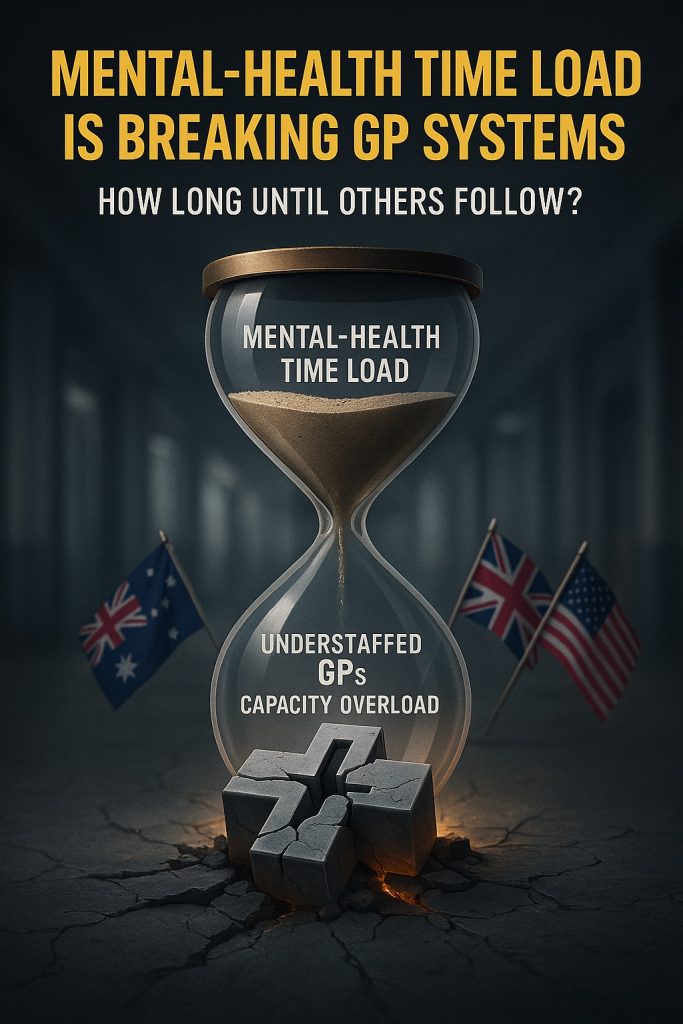
Australia’s GP-based primary care is now saturated with mental-health patients. This is not a simple healthcare issue — it is the first visible fracture in a time-based medical capacity system.
Mental illness does not end in 10 minutes like a cold.
→ mental healthcare consumes time, not just appointments.
The real bottleneck in primary care is not the number of doctors — it is minutes. Australia has crossed into mental health demand > primary care throughput.
This is dangerous because when time collapses, every other disease gets pushed out.
The conclusion is simple:
Mental-health growth is not an event — it is a Time Load that gradually occupies the entire system.
Australia broke first. Other developed nations stand on the same slope.
tone: +3.38
date: 2025-11-18
🔗 Article link
New mental health clinic opens in St Albans (2025-11-19)
https://www.brisbanetimes.com.au/national/victoria/new-mental-health-clinic-opens-in-western-melbourne-as-demand-surges-20251118-p5ngdn.html
Ignored, unaware: mums highlight mental health battles (2025-11-21/22)
https://www.ulladullatimes.com.au/story/9117521/ignored-unaware-mums-highlight-mental-health-battles/
Australians avoid perinatal mental health support (SBS 11.22)
https://www.sbs.com.au/news/podcast-episode/isolation-and-shame-australians-are-avoiding-perinatal-mental-health-support-new-research-reveals/71wsofd52
The crisis is not the rise of mental illness itself —
it is the way mental-health demand consumes primary-care time.
GP capacity = doctors × available minutes
MH demand = patients × counselling time × revisit frequency
General illness → 1–2 visits
Mental illness → dozens of visits, 2–4× duration per session
→ Same doctor → fewer total patients
→ Slight demand increase = exponential bottleneck risk
🌐 The pattern is repeating across advanced economies:
Different triggers, same endpoint: primary-care capacity collapse.
Australia is not failing first — it is simply the first to make noise.
The next affected countries are not random — they follow the same time-load curve.
When mental-health demand outpaces GP throughput, cracks begin from the rear of the system.
| Collapse Stage | Result |
|---|---|
| ① Mental Load Spike | Longer consults, rapid queue expansion |
| ② GP Capacity Shrinks | Chronic/elderly/pediatric care pushed back |
| ③ Screening Delays | Lower early detection of cancer/diabetes |
| ④ ER Overflow | Emergency rooms destabilize → bed scarcity |
| ⑤ Cost Explosion | Insurance pressure + national budget strain |
This is not just medicine.
It is a national sustainability question.
More beds, more money, even AI — none increase time.
Australia is showing the first early signal of systemic strain.
Once mental-health demand exceeds GP time capacity,
advanced healthcare systems will replicate the same pressure and collapse pattern.
Data Source Notice
This article is based on openly available news content collected through the GDELT Global Knowledge Graph (GKG). Tone metrics, metadata, and semantic clusters were processed using Infowider’s proprietary analysis pipeline. No information beyond what is contained in the original articles and GDELT data has been added.


