Physical Address
304 North Cardinal St.
Dorchester Center, MA 02124
Physical Address
304 North Cardinal St.
Dorchester Center, MA 02124
A Delhi explosion, UN criticism of India’s counter-terror policies, and Pakistan announcing successful intelligence-based operations (IBOs) look disconnected — three headlines scattered across a week.
Place them on one timeline, and the picture solidifies.
The blast triggered an expansion of security measures inside India.
The UN quickly intervened — invoking rights and legality to question that response.
Pakistan responded both militarily and rhetorically —
claiming (not independently verified) that the militants were Indian-backed.
This isn’t only about terrorism. It is about power → norms → legitimacy → narrative control operating at the same time. What unfolded here is likely to reappear in:
You don’t read this to know what happened.
You read it to understand how the next conflict will be shaped.
This case behaves less like an isolated event —
and more like a template for how conflicts may unfold.
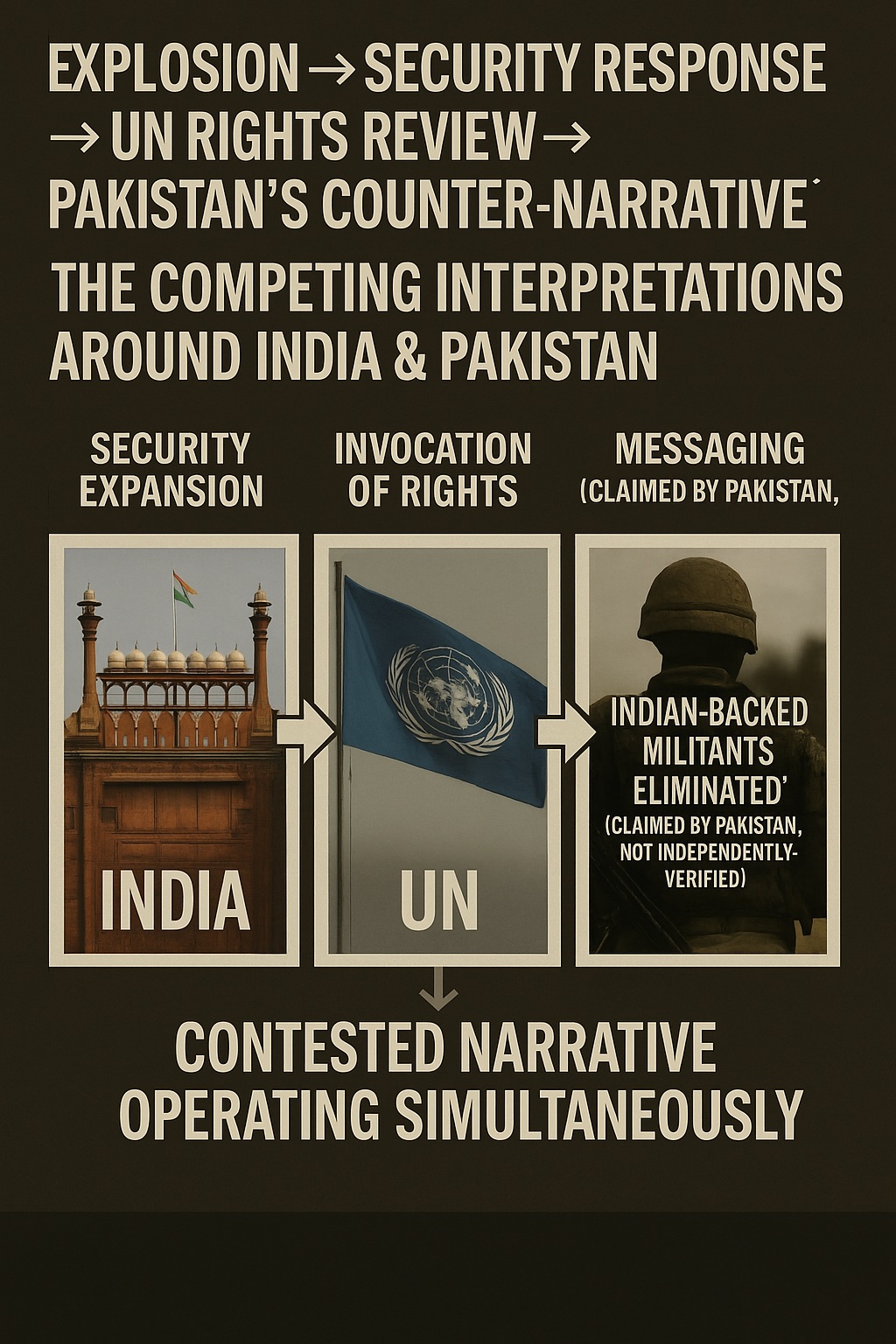
Following the Red Fort explosion, India launched sweeping searches across Jammu & Kashmir, extending into prisons (Kot Bhalwal), Vaishno Devi pilgrimage routes, and Katra commercial zones. This went beyond routine policing —it became a moment where the blast triggered a rapid and large-scale expansion of security measures — a pattern seen in many countries after major terrorist incidents.
UN OHCHR later accused India of rights violations after the Pahalgam attack: 2,800 detentions, 8,000 accounts blocked, deportations, extended UAPA/PSA custody. In other words, security logic collided with a legal and human-rights boundary.
While India faced scrutiny, Pakistan released three consecutive kill reports, according to ISPR and local media:
| Region | Kill Count | Nature |
|---|---|---|
| Kurram | 23 | Two-phase engagement |
| KP province | 30+ | Multi-site operations |
| Bannu | 8 | IBO network disruption |
Each headline repeated one phrase: Indian-backed.
This was not only about operations on the ground — it functioned as an attempt to frame who is sponsoring violence, rather than a confirmed link.
Explosion (Trigger)
→ India expands force
→UN human-rights bodies raised concerns about proportionality and due process — as they routinely do in similar situations worldwide
→ Pakistan flips the frame
These reports behave like a continuous circuit when placed in sequence —
not proven causation, but a visible structural pattern.
Pakistan’s statements repeatedly refer to Indian-backed militants, but
no independent verification currently confirms this claim —
no UN briefing, no third-party intelligence report, and no credible OSINT dataset so far draws a causal link between:
Delhi blast → militants killed in KP → Indian state backing
Until independent confirmation emerges, this stands as a narrative,
useful to study — dangerous to assume.
| Ref | Title | Tone | Date | URL |
|---|---|---|---|---|
| 🇮🇳 #1 | Red Fort blast echo in Jammu as key prisons are searched | -4.07 | 2025-11-20 | Link |
| 🇺🇳 #2 | UN Experts: India Counter-Terror Tactics Violate Rights | -13.23 | 2025-11-24 | Link |
| 🇵🇰 #3 | 23 Indian-sponsored militants killed in Kurram | -2.82 | 2025-11-20 | Link |
| 🇵🇰 #4 | Over 30 Indian-backed militants killed in KP | -4.09 | 2025-11-20 | Link |
| 🇵🇰 #5 | Eight India-sponsored militants killed in Bannu IBO | -1.75 | 2025-11-22 | Link |
The explosion created political space for India to expand security measures.
The UN attempted to re-assert legal and human-rights limits on that expansion.
Pakistan immediately issued statements framing the eliminated militants as Indian-sponsored — a claim that remains unverified by third parties —framing its actions as a response to “Indian-backed” threats,a claim not independently verified.
Pakistan didn’t just report kills — it redirected the spotlight.
Away from itself, and toward India.
This is less a story about one side being “good” or “bad” and more a story about how a multi-actor system operates:
Power → Regulation → Counter-frame → Legitimacy
Read this way, we are not simply consuming news — we are observing how states try to write the rules of engagement and justification.
An explosion is the visible shock.
The deeper struggle happens in the story told around it.
India operates under a security frame.
The UN insists on a legal–rights frame.
Pakistan pushes a narrative frame about sponsorship and blame.
Truth → Fact → Narrative → Legitimacy
Outcomes in this kind of conflict are often shaped less by who exerts the most force, and more by who successfully defines the terms and sequence of the debate.
The key question is shifting from:
“Who is right?” ❌
to
“Who sets the rules and frames?” ⭕
This sequence is likely to repeat — in Gaza, around Taipei, across the Sahel, in the Balkans, and in the Caucasus.
Today, it is India–Pakistan.
Tomorrow, it will be anywhere power meets fear.
In modern conflicts, bombs are only the opening move. The real battle is often over who gets to define what the explosion means.
India controlled the blast.
UN contested the response.
Pakistan fought for interpretation.
Not proof — but redirection.
The explosion happened in Delhi,
but the narrative battlefield ended up in Pakistan.
Repeated kill reports tagged “Indian-backed” reframed the story into an ongoing cross-border conflict —
shifting attention away from the blast itself and toward India–Pakistan militancy.
That shift itself is power.
In this sequence, Pakistan wasn’t proving a link — it was competing to define meaning.
Data Source Notice
This article is based on openly available news content collected through the GDELT Global Knowledge Graph (GKG). Tone metrics, metadata, and semantic clusters were processed using Infowider’s proprietary analysis pipeline. No information beyond what is contained in the original articles and GDELT data has been added.


