Physical Address
304 North Cardinal St.
Dorchester Center, MA 02124
Physical Address
304 North Cardinal St.
Dorchester Center, MA 02124
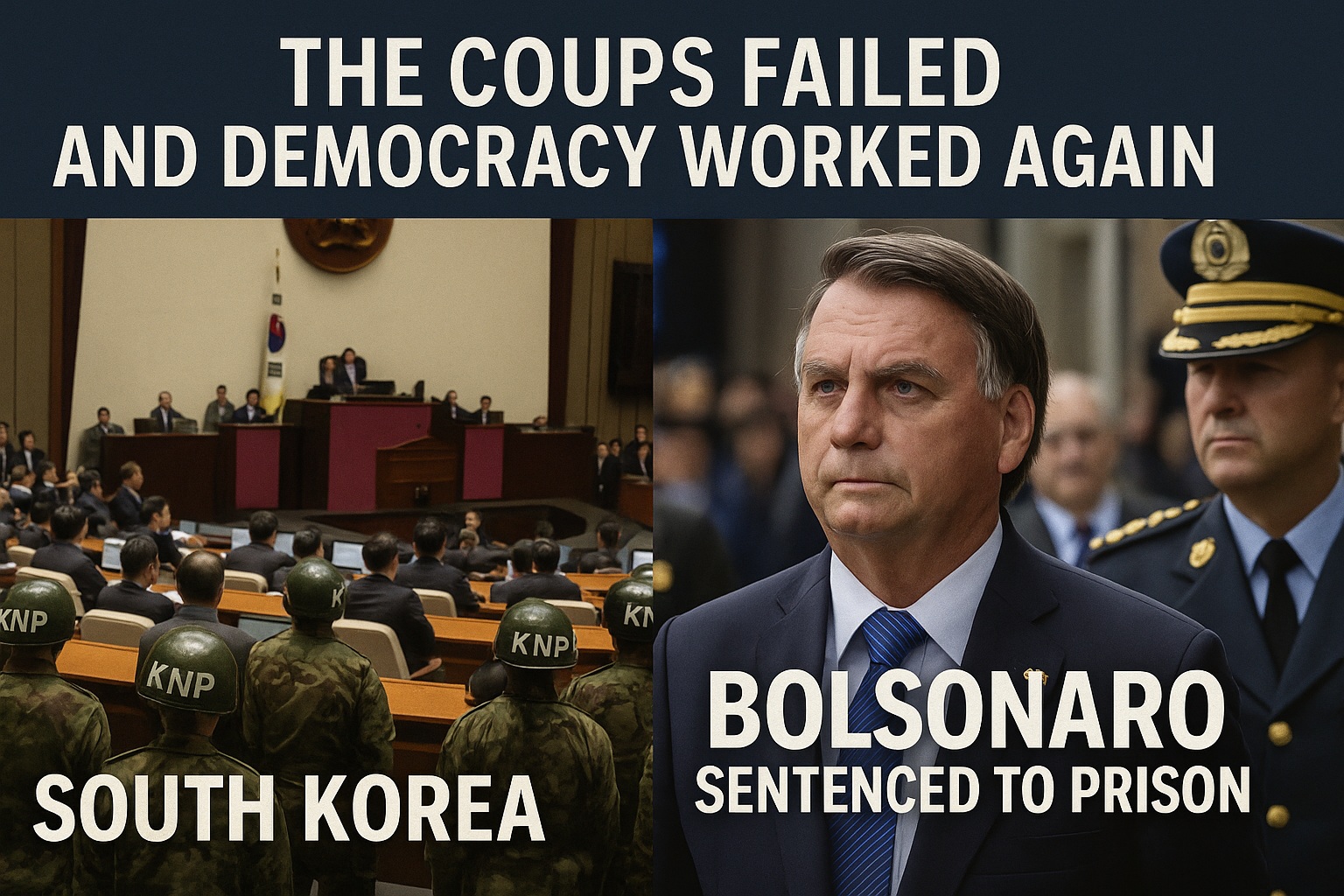
On the night of December 3, 2024, President Yoon Suk-yeol declared emergency martial law and, according to legislative records and national security analyses, ordered military forces to physically remove opposition lawmakers from the National Assembly. Multiple policy institutes and legal journals later classified this as a self-coup attempt.
Ten days later, on December 14, the National Assembly passed the impeachment bill with 204 votes in favor, 96 against. International media including BBC, Reuters, and The Guardian reported the event in real time — framing it as a direct clash between the military, judiciary, and legislature.
On April 4, 2025, Korea’s Constitutional Court (Case No. 2024Hun-Na8) upheld the impeachment and removed Yoon from office. A snap presidential election was held on June 3, 2025, where Lee Jae-myung won with 49.42%, completing a peaceful transfer of power.
South Korea recovered through a clean sequence:
Martial Law → Impeachment → Election → Power Transfer
Not guns or tanks — but constitutional process, public resistance, and military neutrality — sustained democracy.
Brazil’s path unfolded differently — but the pattern was identical.
After losing the 2022 election, Jair Bolsonaro refused to concede. Supporters stormed Congress, drawing immediate global comparison to the 2021 U.S. Capitol Riot. Nationwide tension peaked — yet the Brazilian military leadership refused to intervene politically, and citizens flooded the streets to defend civilian rule.
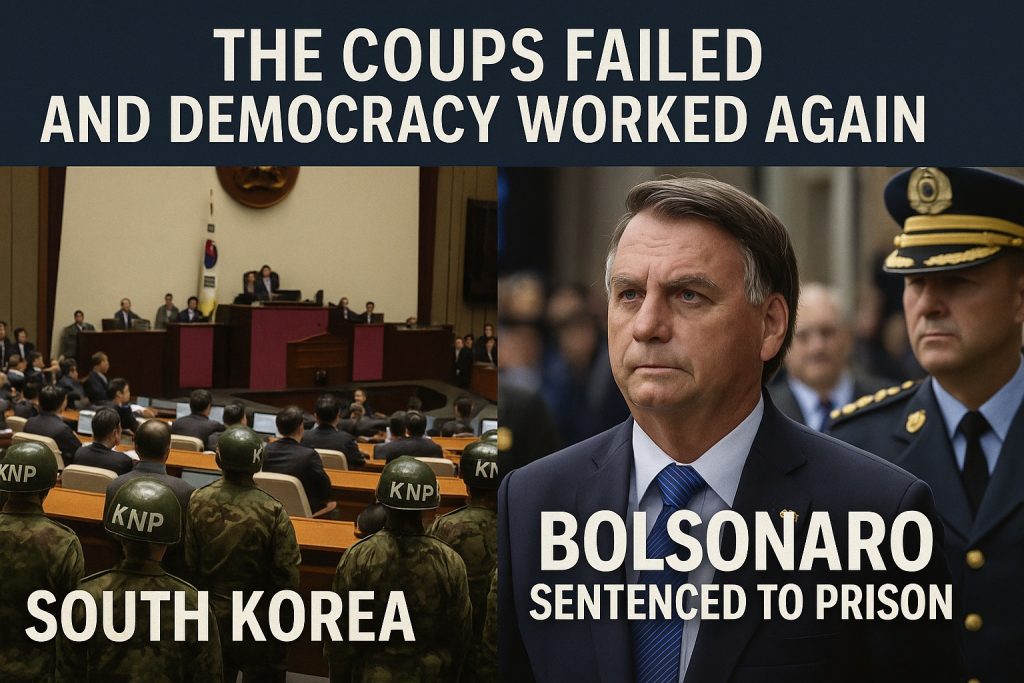
In September 2025, the Supreme Court sentenced Bolsonaro to 27 years in prison, and on November 25, after appeals expired, the order was executed. He was transferred to custody and associates were prosecuted.
The coup failed.
Institutions functioned.
Democracy survived.
What we witnessed was not “political maturity” —
but three structural conditions being met.
| Pillars of Democratic Survival | South Korea | Brazil |
|---|---|---|
| Public Resistance | Mass protests within hours of martial law | Hundreds of thousands in Brasília |
| Military Neutrality | Internal refusal to deploy against parliament | Top brass rejected political intervention |
| Judicial Resolution | Impeachment trial underway | Sentence finalized and enforced |
Where these three collapse, democracy has never survived.
This article is not to praise Korea or Brazil.
The conclusion points outward — not inward.
If your military swears loyalty to a person instead of the constitution,
if courts fall silent,
if citizens become spectators —
The next headline may not say Seoul or Brasília.
It may carry your country’s name.
Democracy does not survive by habit.
It survives only through public vigilance, military neutrality, and judicial courage — especially in crisis.
Korea and Brazil held the line this time.
Who comes next?
South Korea
CSIS – Martial Law Declaration
I·Connect – Constitutional Court Upholds Impeachment
Korea Times – Timeline to Removal
Reuters – Snap Election Coverage
Brazil
Reuters – Coup Plot Sentencing
AP News – Supreme Court Jailing
Al Jazeera – Appeal Rejection Report
If Malava shows why rulers tilt the field,
yesterday’s work looks at how nations survive when power pushes too far.
Continue the thread → Why Power Holders Can’t Resist Rigging Elections
Data Source Notice
This article is based on openly available news content collected through the GDELT Global Knowledge Graph (GKG). Tone metrics, metadata, and semantic clusters were processed using Infowider’s proprietary analysis pipeline. No information beyond what is contained in the original articles and GDELT data has been added.


