Physical Address
304 North Cardinal St.
Dorchester Center, MA 02124
Physical Address
304 North Cardinal St.
Dorchester Center, MA 02124
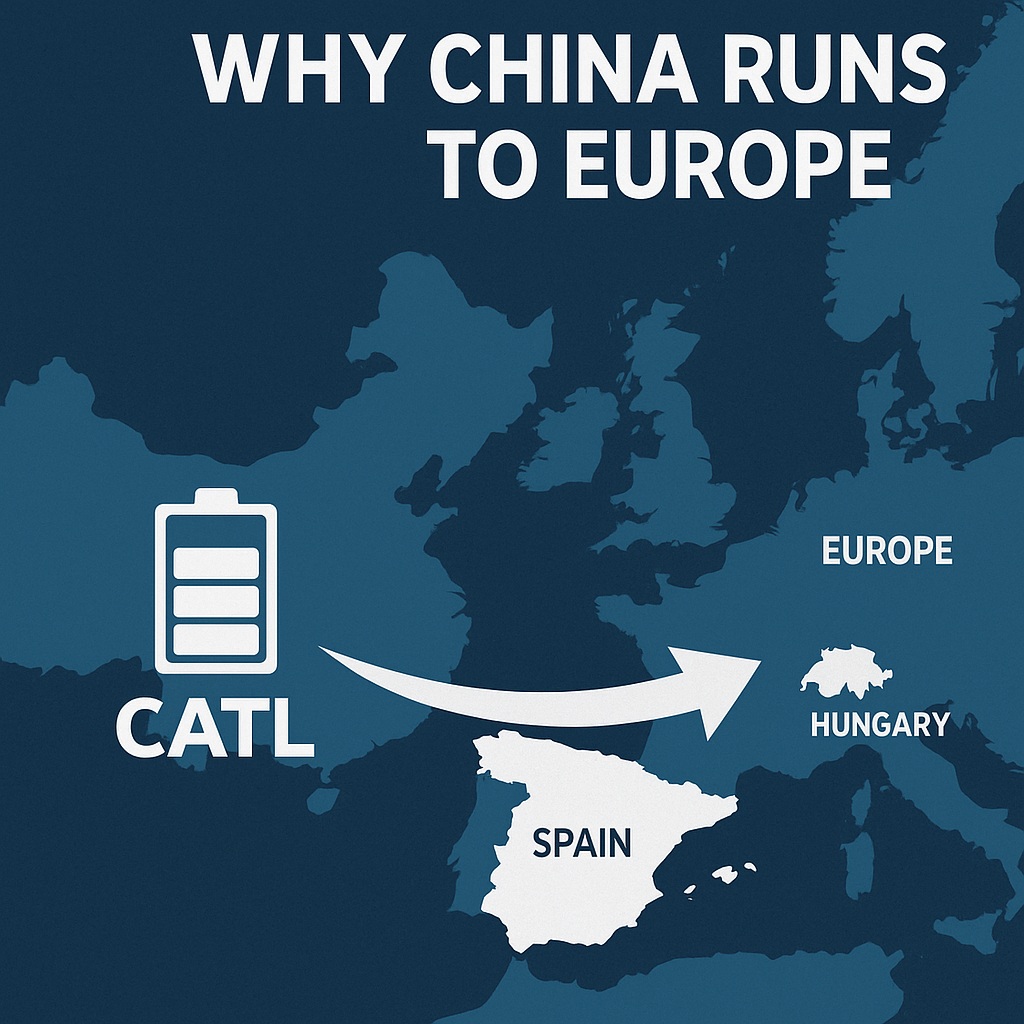
Everyone knows China dominates batteries — the 800-pound gorilla in the room.
So why does it feel like Europe snaps its fingers and China shows up first?
NCM, LFP, solid-state trials, the whole raw-material chain, insane production numbers — they literally built this industry from scratch.
And yet, something about the recent moves just doesn’t line up.
If raw dominance was all that mattered, Western carmakers should be begging at China’s door.
Instead, we’re watching CATL, BYD, and the rest lining up to build gigafactories on European soil first.
This isn’t just “expansion.”
It feels more like someone else is holding the real leverage, and I think these news stories from the past week prove it.
Look at the sequence — it’s almost too neat:
American materials giant Gore just opened a dedicated battery-safety lab… in Shanghai.
They’re testing thermal runaway, venting, explosion suppression — all the scary stuff — shoulder-to-shoulder with Chinese OEMs.
In plain terms, even global safety standards are now quietly taking shape inside China.
Then, literally days later, China pulls off the first commercial air shipment of power batteries with an AI active-safety box.
CATL + civil aviation authority + universities = problem that blocked the entire industry for years suddenly solved.
China didn’t just dominate manufacturing — now it’s quietly moving to dominate logistics too.
But inside China? Totally different vibe.
The MIIT (industry ministry) publicly slaps the wrist of the entire sector for “irrational competition” — code for overcapacity, price wars, and duplicate factories everywhere.
It’s as close as Beijing gets to admitting that the domestic market can’t absorb this much capacity anymore.
So where does the excess go?
Straight to Europe.
Exhibit A: CATL’s €4.1 billion gigafactory in Aragón, Spain.
They’re flying in 2,000 engineers first, and only after that will they train around 3,000 local workers to run the place.
Spanish officials quoted as saying “we’re still in the learning phase.”
That’s not conquest. That’s the market (and its rules) pulling the supply chain by the nose.
China’s strong points are obvious:
But those are just the tickets to the table.
The real game is decided by what China still doesn’t control:
Bottom line: China has the factories.
China may have the factories, but the West still has the customers — and more importantly, the rulebook.
So Chinese giants aren’t marching into Europe shouting “bow down.”
They’re walking in quietly, saying “please let us sell here.”
China is undeniably number one in making batteries.
Yet they’re the ones building factories in Spain, Hungary, and soon France.
Why?
Because the people who write the rules get to decide who plays.
CATL’s Spanish adventure isn’t a champion expanding an empire.
It’s a giant learning to live inside someone else’s gate.
Once you see that, the next five years of the EV-battery war suddenly look a lot clearer.
1. China may dominate battery manufacturing, but Europe and the U.S. still control the demand and the rulebook.
2. Domestic overcapacity + Beijing’s crackdowns mean Chinese firms have to expand into Europe to stay alive.
3. CATL’s Spain move isn’t empire-building — it’s learning to operate under Western rules.
• Beijing Review — Gore opens Shanghai battery-safety lab
http://www.bjreview.com/Business/202511/t20251125_800423982.html
• Xinhua — China debuts AI-based lithium battery air-cargo safety system
https://english.news.cn/20251125/7de846d85da44155aba590985a93cdee/c.html
• MarketScreener — China to crack down on “irrational” battery competition
https://www.marketscreener.com/news/china-pledges-crackdown-on-irrational-competition-in-battery-industry-ce7d51dade8ef322
• Just-Auto — CATL starts work on €4.1bn gigafactory in Spain
https://www.just-auto.com/news/catl-e4-1bn-battery-plant-spain/
Data Source Notice
This article is based on openly available news content collected through the GDELT Global Knowledge Graph (GKG). Tone metrics, metadata, and semantic clusters were processed using Infowider’s proprietary analysis pipeline. No information beyond what is contained in the original articles and GDELT data has been added.


