Physical Address
304 North Cardinal St.
Dorchester Center, MA 02124
Physical Address
304 North Cardinal St.
Dorchester Center, MA 02124
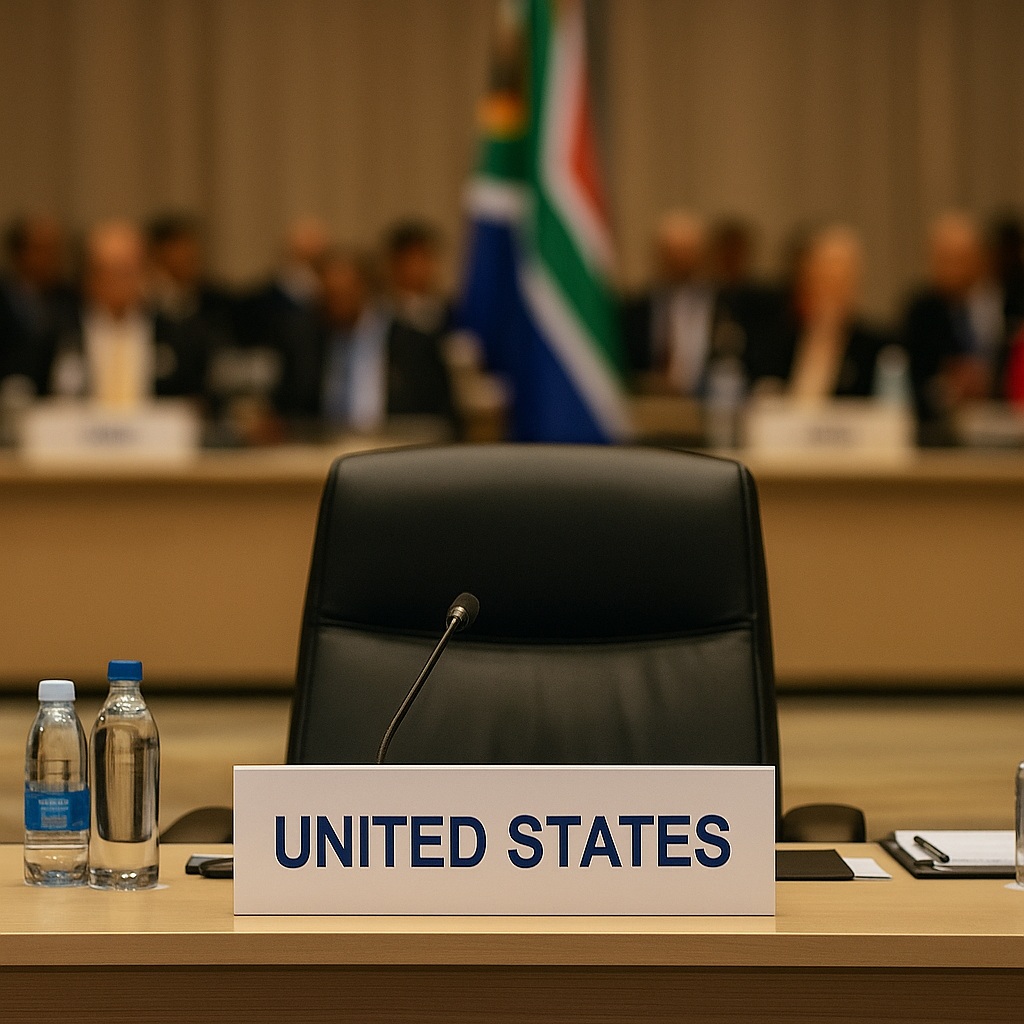
At first glance, America’s absence from the G20 summit in Johannesburg looked like a simple diplomatic snub. Trump justified the boycott by claiming that “white people are being killed in South Africa,” but that was only the surface story. Behind it was a far colder, far simpler political logic.
America is no longer the world’s automatic default. It shows up only when it decides the moment is worth it.
That was the message Trump wanted the world to hear. The instant the U.S. left the room, one question swept across capitals: “Does this forum even work without America?”
Trump wasn’t reacting — he was forcing everyone else to react.
Why South Africa? Trump would never do this to Japan, India, or the EU — the blowback would be too expensive.
Pretoria is different. It has no real military, financial, or diplomatic leverage over Washington. It can complain all it wants; it still can’t walk away from the U.S.-led system.
Add its deepening BRICS romance, cozy signals to Moscow, and foreign policy positions — especially on Israel — that infuriate America’s conservative base, and the math becomes obvious.
Washington loses nothing by slapping South Africa. The rest of the world, meanwhile, freaks out.
In Trump’s playbook, that’s the definition of a perfect target.
The U.S. absence didn’t create a vacuum — it created a stage.
Chinese state media called this “the most Africa-centered G20 in history.” The African Union became a permanent member, and the final declaration mentioned Africa 52 times.
This wasn’t symbolism. It was a loud declaration that the center of gravity in global politics is moving.
Africa, India, Brazil, and parts of the Middle East pushed their agendas with a confidence nobody has seen before.
When the old hegemon yields the floor, others rush to fill it.
When Trump casually suggested South Africa should be kicked out of next year’s summit, the entire G20 wobbled. One sentence from Washington is still enough to make the architecture shake.
But the pushback from other members revealed the new reality: America’s word is no longer law.
We now live in a strange contradiction:
That half-in, half-out posture is what makes the emerging multipolar order so unstable.
The tension didn’t start last month. Years of BRICS expansion, Russia-friendly moves, anti-Israel diplomacy, and growing political distance had been piling up.
Trump’s boycott wasn’t a tantrum. It was the culmination of all that friction, weaponized for maximum effect.
Two uncomfortable questions now hang in the air:
“Who fills the space when America walks away?”
“And is that space still worth coming back to?”
Trump didn’t just skip a summit.
He forced the world to confront something it had taken for granted for seventy years: the assumption that America will always run the show.
Data Source Notice
This article is based on openly available news content collected through the GDELT Global Knowledge Graph (GKG). Tone metrics, metadata, and semantic clusters were processed using Infowider’s proprietary analysis pipeline. No information beyond what is contained in the original articles and GDELT data has been added.


