Physical Address
304 North Cardinal St.
Dorchester Center, MA 02124
Physical Address
304 North Cardinal St.
Dorchester Center, MA 02124
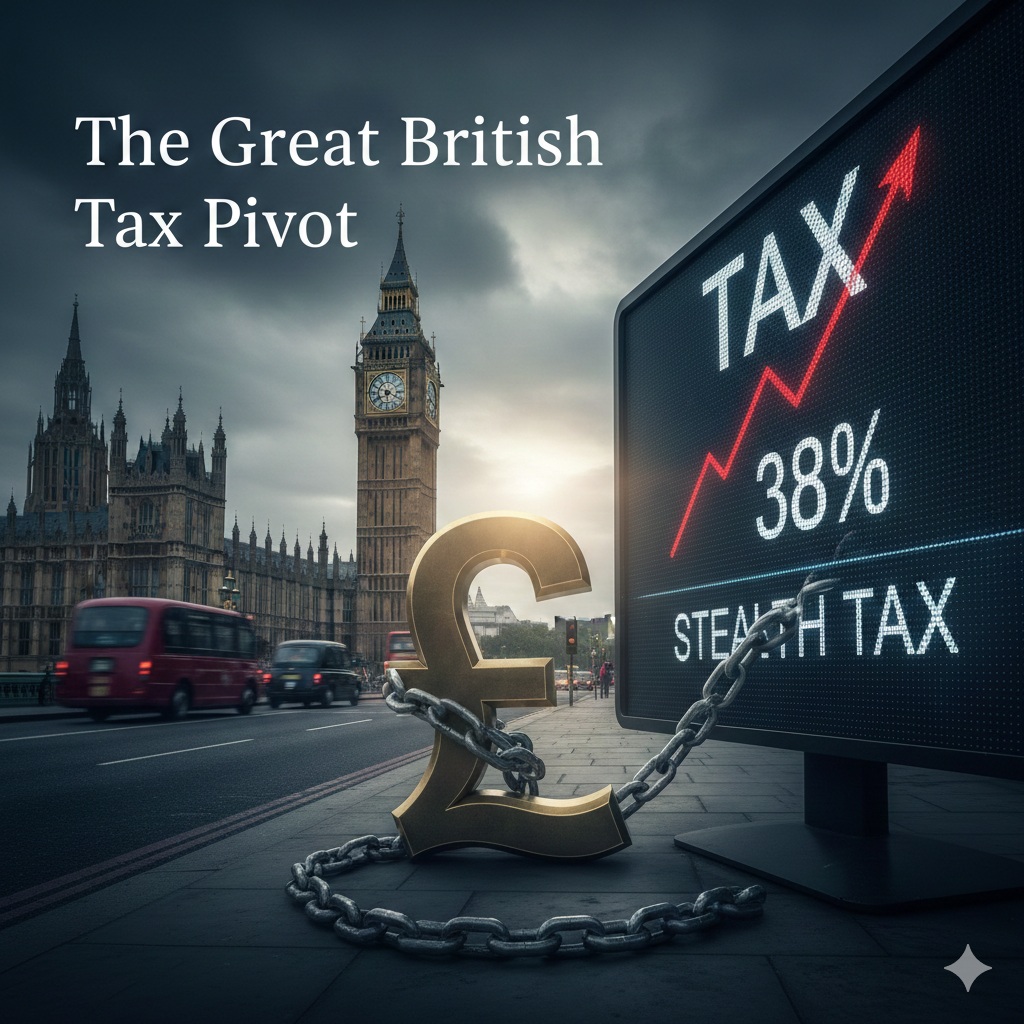
Let’s be honest, for decades, Britain has been the ultimate poster child for a capital-friendly, low-regulation financial hub. The combination of low corporate taxes, generous capital allowances, and a genuinely open door to global capital didn’t just help; it fundamentally powered London’s reign as a financial center.
But the Autumn Budget 2025 is the moment the government stood up and said, loud and clear: That Britain is gone.
With roughly £26 billion in tax increases planned over the next five years, the UK is pushing its tax burden to around 38% of GDP—the highest level seen since the aftermath of the Second World War. This isn’t just a simple exercise in raising revenue; it’s a profound, almost desperate, declaration about the kind of state Britain is reluctantly trying to become.
Here’s the critical point: this is not just a British story.
Britain is simply moving first through a stage that every advanced economy—burdened by crushing post-pandemic debt, aging populations, and chronically low growth—is fundamentally destined to reach sooner or later.
The core genius of this budget, and I use that term loosely, is that the government did not increase the headline income tax rates. They surgically avoided the political pain of a direct rate hike and instead activated a cluster of indirect mechanisms designed to raise maximum revenue while minimizing immediate political backlash.
This is perhaps the most politically cynical maneuver. The key tax thresholds—including personal income tax allowances—are simply frozen for years. As wages track inflation, millions of taxpayers will be pushed into higher tax brackets through the mechanism known as bracket creep.
No legal change is strictly required; time itself is doing the taxing. It’s quiet, it’s gradual, and it places the heaviest, most insidious burden squarely on the shoulders of the middle class whose real-term wages are already stagnating.
Simultaneously, under the political banner of “taxing the wealthy,” the Treasury has zeroed in on asset-based income:
The common thread is crystal clear: the burden is concentrated on immobile assets and taxpayers who cannot easily leave the country.
On paper, these measures sound like a fair fight against high-net-worth individuals. Structurally, the outcome is inevitably different.
Ultra-wealthy individuals, sophisticated corporations, and global capital itself are fundamentally mobile. They are already adapting and voting with their feet.
What remains are the immobile groups: salaried workers, pensioners, and the upper-middle-income residents tied to the domestic economy. They are the captive audience for taxation—the reliable cash cow the Treasury can bank on.
This isn’t a simple policy error. It’s a late-stage, desperate adaptation by the modern state in an era where global capital is free, but the average citizen is not.
Large-scale taxation—especially one targeting complex assets—requires ruthlessly closing every escape route. Britain has unequivocally paired its tax shift with a significant acceleration of digital enforcement.
Starting in 2026, HMRC will implement CARF, demanding that crypto exchanges report transaction data for UK-resident clients. The message is chillingly clear: Cryptocurrency is no longer a gray zone. It is being fully absorbed into the tax system.
Furthermore, tax reliefs and allowances increasingly require active claims from the taxpayer. This is not about convenience; it’s about ensuring tax authorities maintain granular, digital records of your entire financial activity. What Britain is truly changing is not just the tax level, but the enforcement power and surveillance density of the state.
To dismiss this as a uniquely British administrative mess would be a fatal mistake for any global asset holder.
We have seen this script played out before: France tried explicit hikes, Italy shifted the burden through indirect taxes, and the United States has largely used inflation as an invisible form of taxation.
The methods differ, but the direction is universally the same.
Britain hasn’t created a new problem. It has simply made an old, global one harder to ignore.
Britain’s tax pivot ultimately reduces to one essential, unavoidable question:
How is your country charging you for state failure today?
And most people already know the answer. They just haven’t named it yet.
Is it through explicit tax hikes? Through stealth taxation? Or through currency debasement?
The moment you answer that question truthfully, your choices about asset allocation, residence, and long-term investment strategy must change.
Taxes are no longer just numbers—they are the language of country risk.
1. Britain’s 2025 tax overhaul is about reallocating the cost of state failure, not just raising rates.
2. The burden is shifting from mobile capital to immobile assets and citizens via ‘Stealth Tax’ and digital enforcement.
3. The UK is an early warning—not an exception—for every mature, indebted economy globally.
Data Source Notice
This article is based on openly available news content collected through the GDELT Global Knowledge Graph (GKG). Tone metrics, metadata, and semantic clusters were processed using Infowider’s proprietary analysis pipeline. No information beyond what is contained in the original articles and GDELT data has been added.


