Physical Address
304 North Cardinal St.
Dorchester Center, MA 02124
Physical Address
304 North Cardinal St.
Dorchester Center, MA 02124

Today’s headlines are deceptively calm.
“The Fed cuts rates to a three-year low.”
Markets were told to celebrate. But buried inside Reuters’ reporting was a word that should sober any serious reader: “fractious.”
This was not a harmonious pivot.
It was a split decision, the outcome of a bruising internal fight between hawks and doves. The evidence is visible in the Fed’s own dot plot: only one rate cut projected for 2026.
That is not a gift.
It is a warning.
Markets assumed easing would continue smoothly. The Fed does not agree.
According to Reuters, the median FOMC projection shows just one cut in 2026, a stark contrast to market pricing. The implication is uncomfortable but clear: the Fed is cutting now not because inflation is defeated, but because recession risks are becoming politically and economically unbearable.
This cut tells us what the Fed is afraid of — and what it is not
This is not a growth-friendly pivot.
It is a defensive retreat — a cut with stagflationary characteristics.
* Watch Powell closely. The hesitation matters more than the words.
The policy message sounds calm. The delivery is not.
The Fed is easing while remaining deeply afraid of inflation’s return. That contradiction guarantees instability. When policy is driven by fear rather than conviction, credibility erodes quickly.
Normally, a rate cut pulls bond yields lower. That did not happen cleanly this time.
As Business Insider highlighted, bond yields have shown signs of moving in the opposite direction. Long-dated Treasuries refuse to rally convincingly, even as the Fed loosens policy.
The market is asking a different question than the Fed.
Who will absorb America’s debt?
The issue is no longer just interest rates — it is supply, deficits, and trust. The U.S. continues to issue enormous volumes of debt, and investors are increasingly reluctant to lock in long-term exposure without compensation.
When policy rates fall but market rates resist, that is not a technical anomaly. It is a signal of systemic strain.
The bond vigilantes are not gone.
They are waiting.
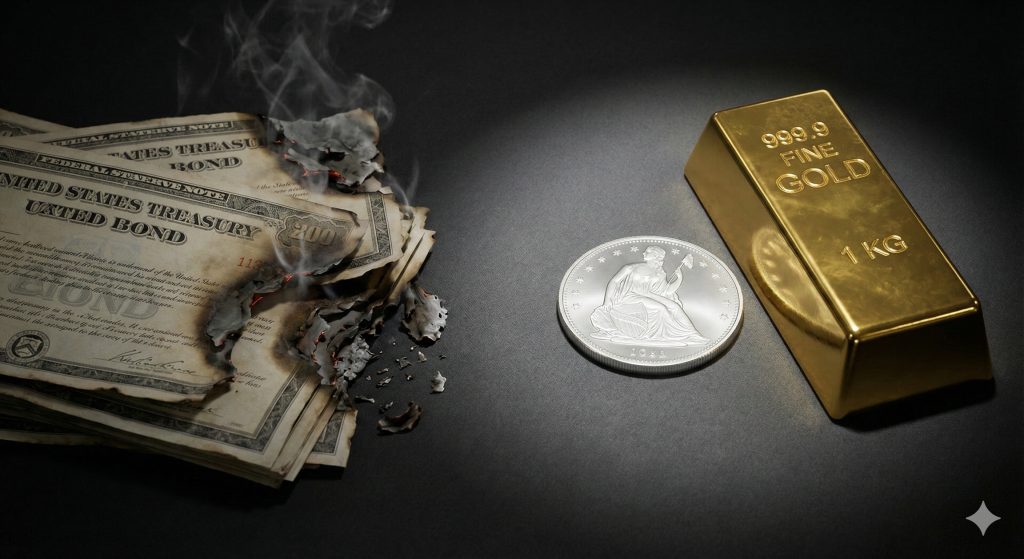
While stocks debate narratives and bonds argue with policy, real money quietly voted.
According to Reuters, silver hit record highs, while gold continued to climb. This was not speculative frenzy. It was allocation behavior.
Smart capital is not chasing returns — it is hedging credibility risk.
Silver’s outperformance is especially telling. It reflects not just inflation anxiety, but distrust in monetary coordination. When central banks appear divided, metals benefit from one simple truth:
They do not require consensus to preserve value.
This is not a vote against the dollar itself.
It is a vote against policy coherence.
This rate cut did not restore confidence.
It exposed fragility.
The Fed looks divided.
Markets are no longer aligned with policy signals.
Capital has started choosing silence over promises.
That combination rarely produces stability.
Do not open champagne over a headline rate cut.
The Fed has not pivoted with conviction — it has retreated under pressure. Leadership looks strained, policy signals are conflicted, and markets are already positioning for turbulence.
2026 will not be liquid. It will be selective.
When bonds fail to protect, gold and silver historically do.
The message is not fear.
It is preparation.
Data Source Notice
This article is based on openly available news content collected through the GDELT Global Knowledge Graph (GKG). Tone metrics, metadata, and semantic clusters were processed using Infowider’s proprietary analysis pipeline. No information beyond what is contained in the original articles and GDELT data has been added.


