Physical Address
304 North Cardinal St.
Dorchester Center, MA 02124
Physical Address
304 North Cardinal St.
Dorchester Center, MA 02124
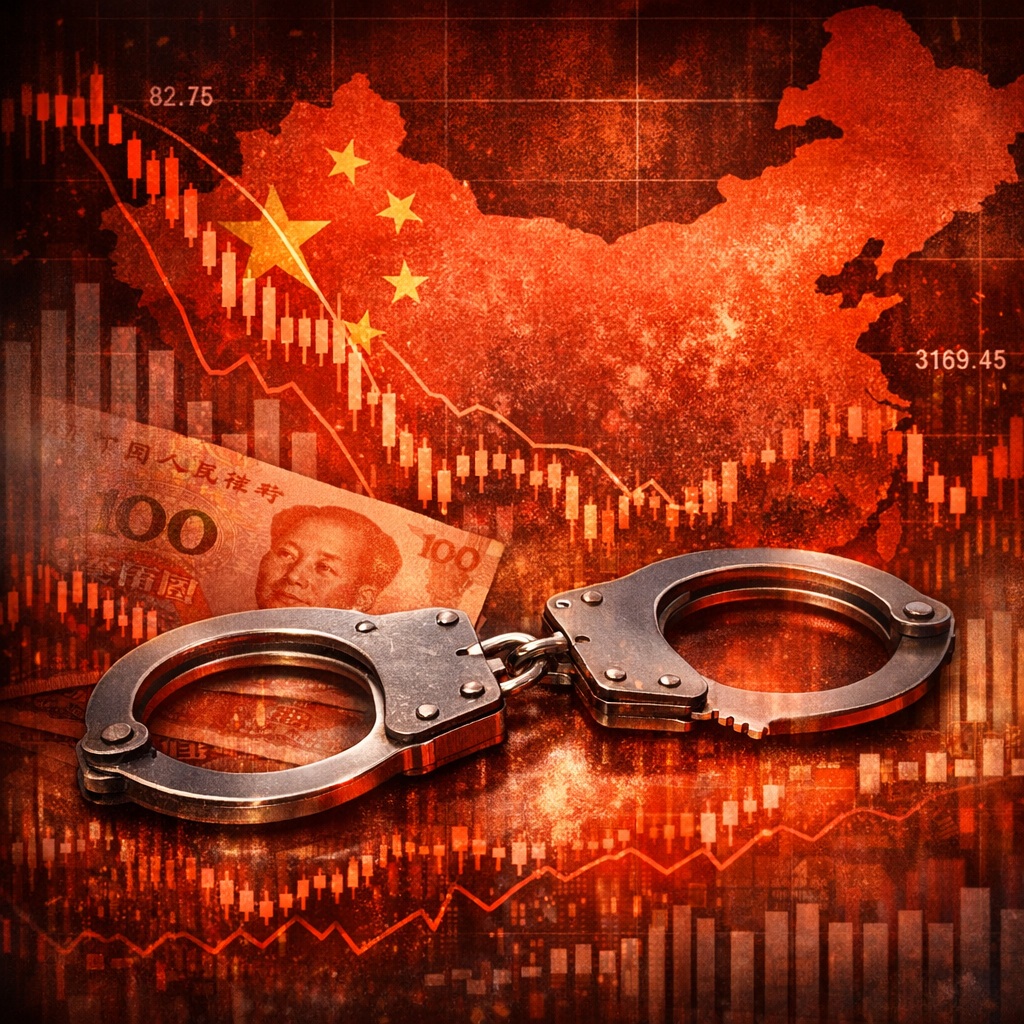
What Beijing previously categorized as structural reform—bank consolidations and centralized oversight—has evolved into a phase of explicit discipline. The objective is no longer merely to prepare financial institutions for stress, but to impose rigid control over the individuals operating them. This transition signals that transparency and market-based loss recognition are politically discarded options. The system is now managed through containment rather than correction, marking a fundamental change in China’s crisis management playbook.
The immediate execution of Bai Tianhui, former head of Huarong’s overseas unit, deviates significantly from the customary “death sentence with a two-year reprieve.” The absence of this reprieve indicates a deliberate escalation by the Supreme People’s Court. The scale of the bribe—RMB 1.1 billion (approx. USD 150 million)—provided the legal justification, but the political timing reveals the true intent. Huarong serves as the primary repository for China’s distressed assets. By targeting a key figure in this specific ecosystem following the execution of its former chairman Lai Xiaomin in 2021, Beijing is issuing a calculated warning: the disclosure of hidden liabilities is a capital offense. It imposes absolute silence on those closest to the system’s fault lines.
The timing of the execution aligns precisely with the default of wealth management products (WMPs) in Zhejiang province, China’s economic powerhouse. The default, involving roughly USD 3 billion, is particularly sensitive because it inflicted losses on public sector employees and state-linked individuals. These simultaneous events—punitive action against an elite banker and the containment of a regional default—reveal a unified risk-management strategy. Beijing is deploying fear to substitute for liquidity. The priority is to suppress the transmission of panic from the local level to the broader economy by ensuring that news of insolvency does not spread beyond the immediate victims.
For decades, Chinese finance operated on the implicit guarantee that the state would backstop losses. That guarantee is fading. In its place, the state has introduced the explicit threat of severe punishment for “disorderly behavior.” This shift fundamentally alters the incentive structure for Chinese bankers. The goal is no longer profit maximization or even risk management, but political alignment. This creates a zombie banking dynamic where institutions freeze lending to avoid potential political backlash, further choking the real economy.
Surface-level calmness in Chinese markets should be interpreted as the result of strict administrative suppression, not organic resilience. Risk has not been resolved; it has been compressed under layers of political control. As market mechanisms for pricing risk are dismantled, volatility is replaced by opacity. For global investors, this implies that traditional indicators—NPL ratios, reported GDP, and corporate balance sheets—are no longer reliable proxies for health. The absence of bad news is now a product of policy, not performance.
International markets must adjust to a China where financial data is a state secret.
Capital Flows: Expect increased volatility in emerging markets as global funds withdraw from an opaque Chinese system.
Commodities: The suppression of credit to maintain stability will likely dampen demand for industrial metals (copper, iron ore) despite stimulus announcements.
Strategy: Investors should treat Chinese assets not as value plays, but as policy derivatives. The risk is no longer just economic; it is the inability to see the cliff before falling off.
China has shifted from structural reform to “enforcement by fear,” executing bankers to impose silence on hidden debt.
This strategy replaces the implicit state guarantee with explicit threats, prioritizing the containment of panic over the resolution of insolvency.
For global investors, the apparent stability is artificial; it reflects political suppression rather than economic health.
This article follows China’s earlier phase of financial restructuring, where institutional consolidation was used to absorb systemic stress. As that approach reaches its limits, enforcement has emerged as the next instrument of control.
Data Source Notice
This article is based on openly available news content collected through the GDELT Global Knowledge Graph (GKG). Tone metrics, metadata, and semantic clusters were processed using Infowider’s proprietary analysis pipeline. No information beyond what is contained in the original articles and GDELT data has been added.


