Physical Address
304 North Cardinal St.
Dorchester Center, MA 02124
Physical Address
304 North Cardinal St.
Dorchester Center, MA 02124
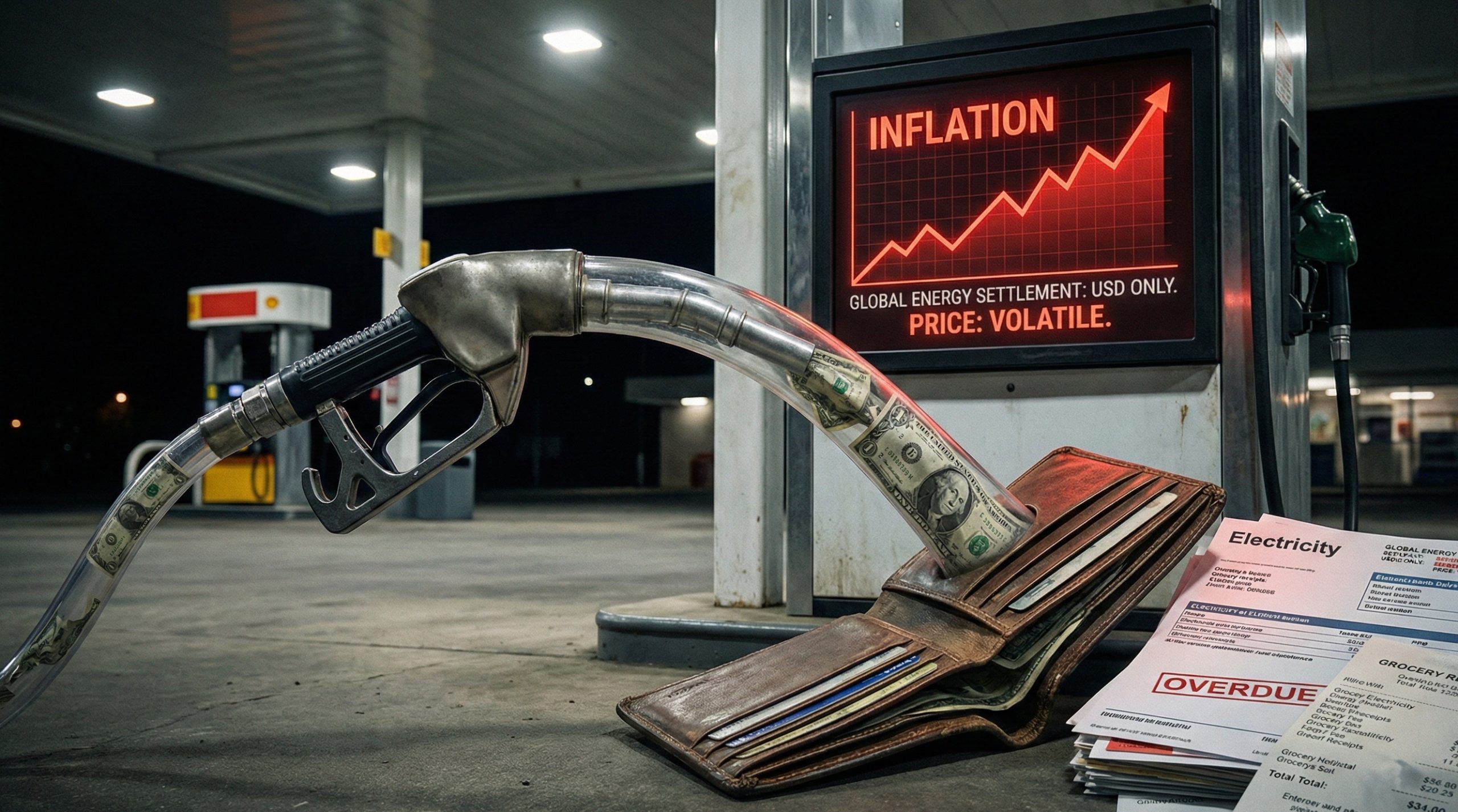
Your gas bill and electricity costs are no longer set by the market. They are set by dollar enforcement.

The U.S. strike on Venezuela was not regime change. It was a financial–military enforcement action meant to drag oil back into the American legal and settlement system. The moment Maduro was reclassified not as a president but as a criminal, Venezuela’s oil fields, tankers, insurance, and payment accounts shifted from sovereign assets into seizable criminal proceeds. That was more powerful than occupation, because oil returned to New York’s jurisdiction.
Washington moved not because prices were high, but because the dollar was being bypassed. Russia, Iran, Venezuela, and China had been trading crude through yuan settlements, barter, shadow insurance, and opaque shipping networks. Oil was flowing, but the United States could no longer sanction it, trace it, or block it. So instead of manipulating price, Washington chose to re-anchor settlement to the dollar.
Venezuela holds the world’s largest proven reserves and had become a de-dollarized energy hub backed by Chinese collateral, Iranian shipping, and Russian protection. By legally disabling that hub, oil that had circulated outside the dollar system was forced back into U.S. legal and financial control. That is why the real target was not Caracas, but the currency in which oil is settled.
When oil can only be traded legally in dollars, the United States shapes the market not through production, but through access to settlement. That pressures Russia and Iran, raises China’s energy costs, and rewires the global inflation path at the same time. This was not a military story. It was a structural shift linking currency, commodities, and prices.
Energy sits at the base of electricity bills, transportation costs, food prices, and airfares. Which currency governs that energy sets the upper and lower bounds of those prices. Today it was Venezuela. Tomorrow it could be the Middle East. After that, Asia’s energy. The more the dollar regains control over energy, the more volatile your cost of living becomes.
Maduro’s capture was not the fall of a country. It was the moment ownership of oil shifted from the market to dollar enforcement; in a world where energy belongs to a currency, prices are no longer neutral.
The core of the Venezuela event was not regime change — it was a financial–military enforcement move to pull oil back under the dollar settlement system.
The moment Maduro was reclassified from “president” to “criminal,” Venezuela’s oil fields, tankers, insurance, and payment channels shifted into U.S. legal jurisdiction and dollar control.
From here, inflation and your cost of living are set less by “the market” and more by how tightly the dollar enforces control over energy settlement.
This article is based on publicly available reporting from international news outlets.
Analysis and interpretation were produced by Infowider’s editorial framework.
No claims have been added beyond what is supported by the cited sources.


