Physical Address
304 North Cardinal St.
Dorchester Center, MA 02124
Physical Address
304 North Cardinal St.
Dorchester Center, MA 02124


People blame exchange rates or inflation when Netflix, YouTube Premium, app subscriptions, and delivery fees start creeping up again. But the real cause sits much farther away — inside a courtroom in New Delhi. India has just told Apple, Google, and Amazon that the rules for punishing Big Tech are changing. This isn’t a tech policy update. It is a repricing of your cost of living.
In 2024, India changed how antitrust fines are calculated. Previously, penalties were based on “10% of what you earned in India.” Now they are based on “10% of what you earned globally.” If Apple abuses its power in India’s App Store, the iPhones sold in the U.S. and the app fees collected in Europe become part of the fine calculation. This is not a tax. It is a price tag placed on the entire platform empire.
The reason is simple. Big Tech is no longer local. Search, payments, advertising, app distribution, and cloud services form a single global system. That is why India’s regulators are saying: “If market power is global, punishment must be global too.” The European Union has used this model for over a decade. India has now formally adopted it.
Apple warns that this method could lead to fines as high as $38 billion. But what truly scares Apple is not the number. It is the possibility that India becomes a model. If this logic holds in India, Brazil, Indonesia, Mexico, and Turkey will copy it. At that point, a violation in any one country puts a company’s entire global revenue at risk.
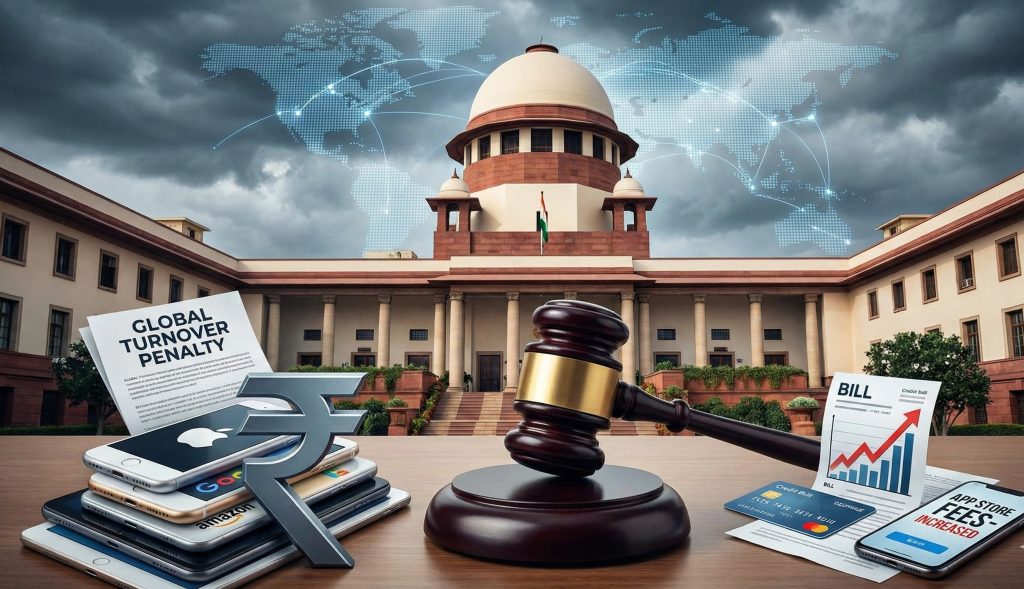
When Apple or Google pays a fine, the money does not come from shareholders. It comes from users.
App Store fees go up.
Advertising costs rise.
Subscription prices increase.
Delivery platform payouts change.
When governments tax platforms, platforms tax consumers.
This is not theory. It is a pattern — repeated across continents.
In the European Union (2024), regulators forced Apple to open its App Store after Spotify and other developers filed competition complaints under the Digital Markets Act. Apple complied — but did not cut its margins. Instead, it introduced a new “Core Technology Fee” of €0.50 per app installation, while still charging up to 17% commission on App Store sales. Regulation did not make apps cheaper. It created a new fixed cost, which developers passed on through higher prices, subscriptions, and advertising.
In South Korea (2021), lawmakers banned Google and Apple from forcing in-app payment monopolies. Google technically allowed alternative payment systems — but only reduced its fee from 30% to 26%. The law was meant to lower prices. In practice, it simply shifted the cost, squeezing developers and pushing them toward price increases.
In Australia (2021), the government forced Google and Meta to pay news publishers for using their content. Neither company absorbed the cost. Google adjusted ad-revenue sharing. YouTube rewrote monetization formulas. The platforms kept their margins — and passed the bill on.
Across markets, the same rule holds:
Platforms never pay.
They invoice.
Now India is applying this logic at global scale.
By calculating fines based on worldwide revenue, India is not regulating Apple’s Indian business. It is repricing Apple’s entire global operation. And just like in Europe, Korea, and Australia, that cost will not stay inside Apple.
It will flow through:
Until it lands on the end user.
India is not simply punishing Apple. India is asserting its right to reclaim the excess profits of platform empires. The bill is calculated in New Delhi — but it shows up on your credit-card statement.
Governments have learned how to price platform empires.
Platforms have learned how to forward that price.
So every new regulation becomes a new charge on your screen —
hidden inside the apps you pay for.
This article is based on publicly available reporting from international news outlets. Analysis and interpretation were produced by Infowider’s editorial framework. No claims have been added beyond what is supported by the cited sources.


