Physical Address
304 North Cardinal St.
Dorchester Center, MA 02124
Physical Address
304 North Cardinal St.
Dorchester Center, MA 02124
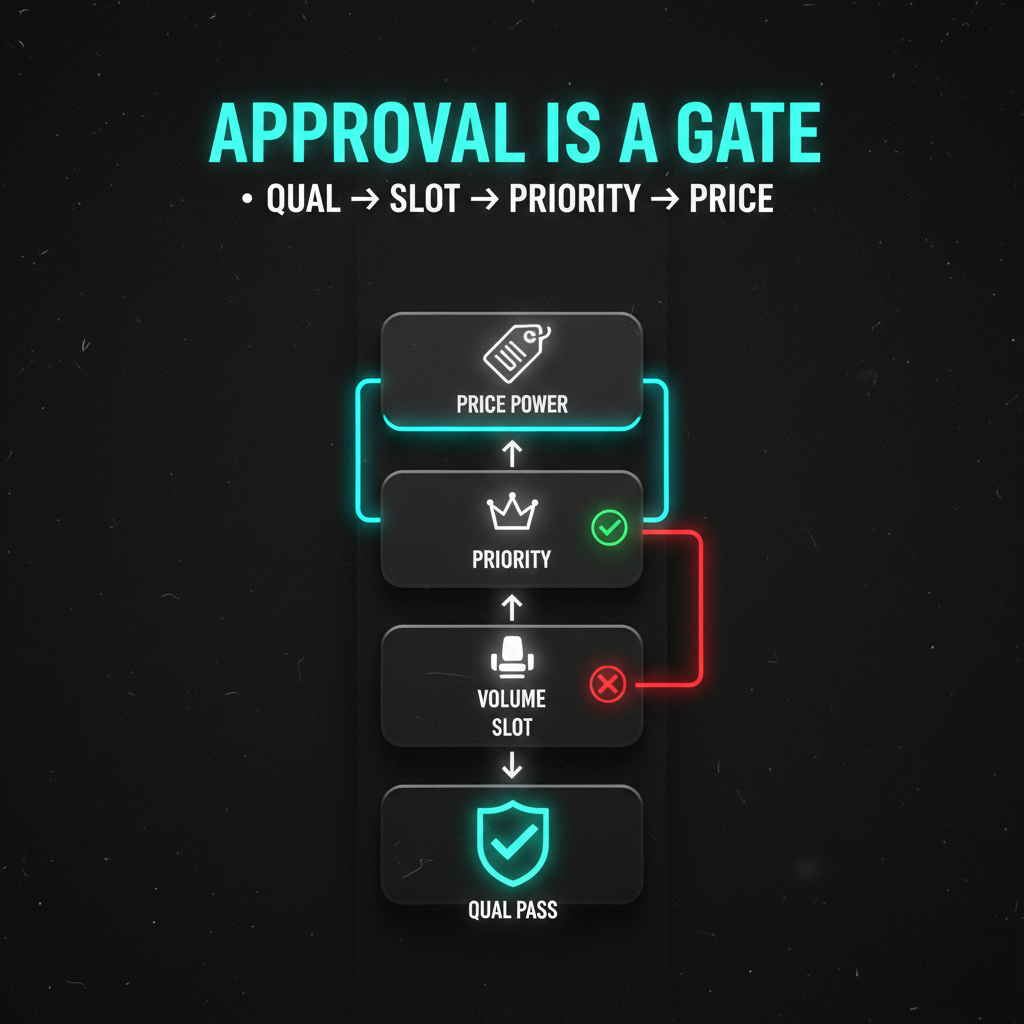
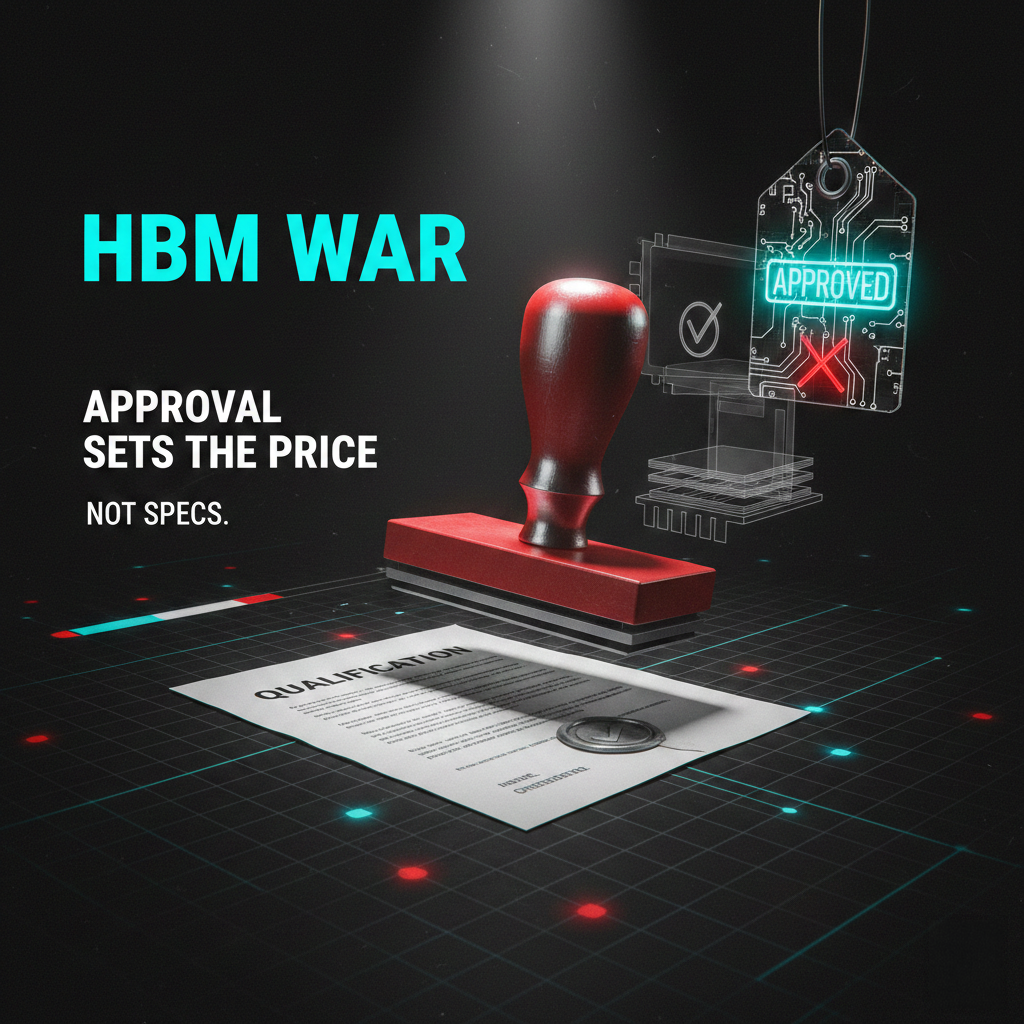
HBM winners are priced by who gets qualified, not who talks the best specs.
A fried-chicken meetup in Silicon Valley reads like PR. In an AI supply-chain war, it’s closer to a capacity calendar. When the platform owner and a top supplier sit down, the market reads one thing: who is being pulled into the next timeline.
That matters because, in HBM, the scarce resource isn’t “a better datasheet.” It’s approval power—the sequence of validation gates, volume commitments, and delivery credibility that decides who ships into the next accelerator cycle.
On Feb. 12, Samsung said it began shipping HBM4 to customers and highlighted “a consistent processing speed of 11.7 Gbps… a 22% increase” with a “maximum speed of 13Gbps.” Reuters
That’s not just a performance claim. It’s a qualification pitch: stable throughput + predictable delivery—the two things approval regimes reward.
When a platform buyer sits at the top, “technology” becomes the language of gates:
This is why “being in the room” matters more than being loud. The room is where next-quarter capacity gets matched to next-generation product plans, and where the buyer’s approval framework becomes the de facto price-setting mechanism.
A concrete signal: SK Group Chairman Chey Tae-won met Nvidia CEO Jensen Huang at a Silicon Valley Korean chicken restaurant on Feb. 5, and the meeting was widely believed to include “supply plans for HBM4” for Nvidia’s next accelerator, “Vera Rubin.” Korea Joongang Daily
That’s the market’s tell: approval is negotiated upstream, then enforced downstream.
HBM4 isn’t treated like “one more generation.” It’s treated like a bottleneck prize—because AI accelerators scale only as fast as memory bandwidth and packaging can sustain.
So the contest moves from “DRAM performance” to integration survivability:
Samsung’s framing—shipping now, sampling next—puts the emphasis on sequencing: shipable stability first, then expansion later. It even said it planned to deliver samples for “HBM4E” in the second half of 2026. Reuters
That’s a roadmap that maps to approval logic: get into the regime first, optimize later.
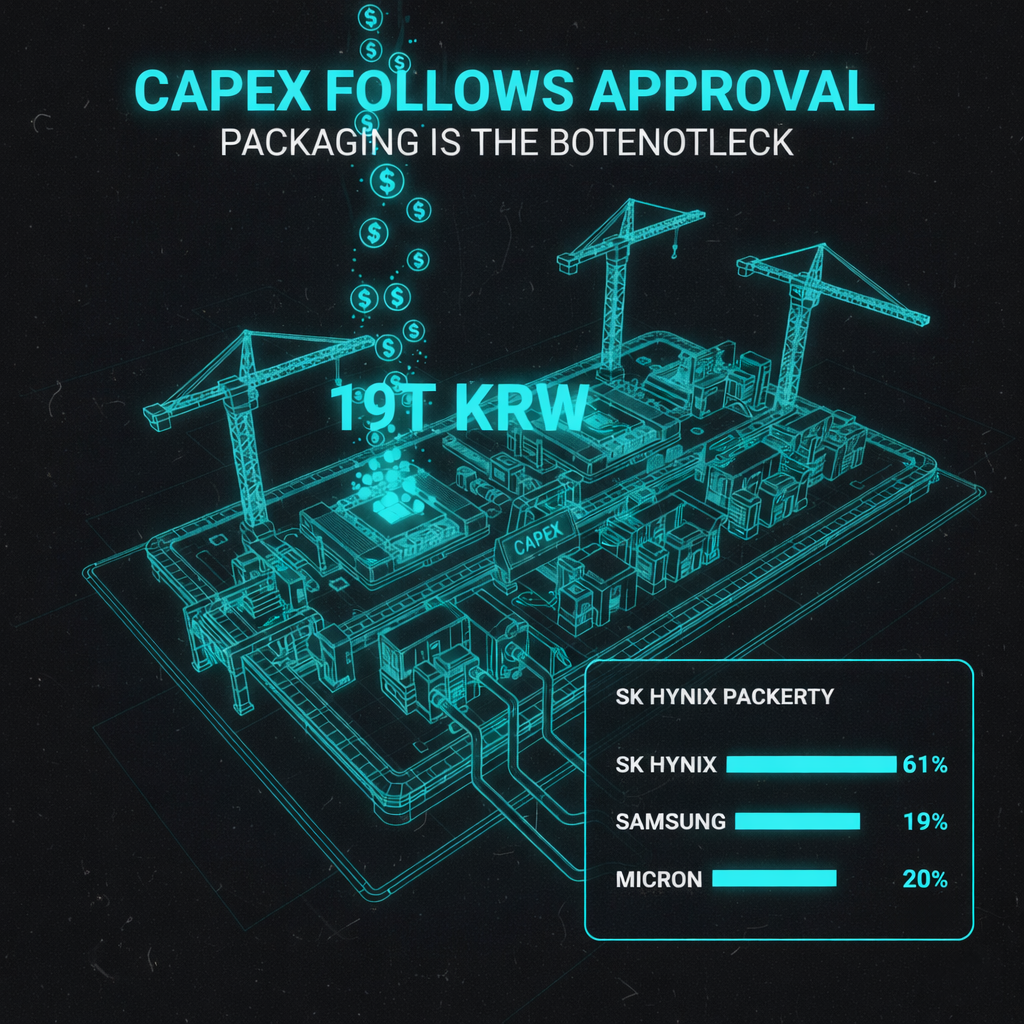
If approval prices the winners, then capital spending follows the choke point.
SK hynix said it would invest 19 trillion won (about $12.90 billion) to build an advanced chip packaging plant, with construction beginning April 2026 and completion targeted by end-2027. Reuters
That is not “innovation theater.” It’s the cost of staying inside the approval regime when packaging becomes the constraint.
The same Reuters report cites HBM market shares (Macquarie Equity Research): SK hynix 61%, Samsung 19%, Micron 20%. Reuters
That distribution is the scoreboard of who already holds the approval pipeline—and therefore who can most efficiently convert capex into locked-in priority.
When supply-chain competition tightens, enforcement hardens—not as morality, but as pricing.
A former Samsung Electronics vice president was sentenced to three years in prison for leaking confidential information, with the court calling it a serious offense undermining fair market order. The Star
A prison sentence is not gossip. It is a cost signal: leakage risk is priced through prosecution, not just contracts.
That cost diffuses downward:
In other words: the ecosystem pays to prevent knowledge from leaving, because the approval regime prices not just performance—but control and containment.
When the system changes fast, costs appear first as governance structures, not as clean “labor statistics.”
In Korea, the Korean Confederation of Trade Unions (KCTU) launched a joint consultative body with the government to address AI-driven workplace anxiety; representatives will meet monthly, and the government also planned a similar structure with business groups on Feb. 24. 코리아 타임스
That’s not “fear management.” It’s burden allocation: who pays for reskilling, stability, and transition support—and under what rules.
In the HBM supply-chain war, the decisive asset is survival inside the buyer’s approval regime—and the costs of that survival (qualification, packaging capex, control enforcement) are pushed downward across the industrial ecosystem.
Confidence: MED
Falsifier: If publicly tracked indicators show HBM4 expansion coinciding with decreasing qualification friction (faster approvals, fewer supply constraints) while supplier margins and labor outcomes broadly improve, the “downward cost pass-through” thesis weakens.
SK, Nvidia chiefs talk AI chips over ‘chimaek’ in Silicon Valley
https://www.koreaherald.com/article/10673850
Samsung Fires the Starting Gun on HBM4: Inside the Race to Build the Memory Chips That Will Define the Next Era of AI
https://www.webpronews.com/samsung-fires-the-starting-gun-on-hbm4-inside-the-race-to-build-the-memory-chips-that-will-define-the-next-era-of-ai/
Former Samsung Electronics vice-president sentenced to 3 years’ jail for leaking company secrets
https://www.thestar.com.my/aseanplus/aseanplus-news/2026/02/11/former-samsung-electronics-vice-president-sentenced-to-3-years-jail-for-leaking-company-secrets
Labor, gov’t launch consultative body as concerns rise over AI replacing human workers
https://www.koreatimes.co.kr/southkorea/society/20260211/labor-govt-launch-consultative-body-as-concerns-rise-over-ai-replacing-human-workers
(Supplementary) SEMICON Korea: Samsung pushes hybrid bonding HBM, SK Hynix bets on platform AI
https://www.digitimes.com/news/a20260212PD213/samsung-sk-hynix-2026-hbm-development.html
This article is based on publicly available reporting from international news outlets. Analysis and
interpretation were produced by Infowider’s editorial framework. No claims have been added beyond
what is supported by the cited sources.


