Physical Address
304 North Cardinal St.
Dorchester Center, MA 02124
Physical Address
304 North Cardinal St.
Dorchester Center, MA 02124
Elections are supposed to be contests.
In too many countries they’ve become something else entirely: a survival ritual where the incumbent must win at any cost.
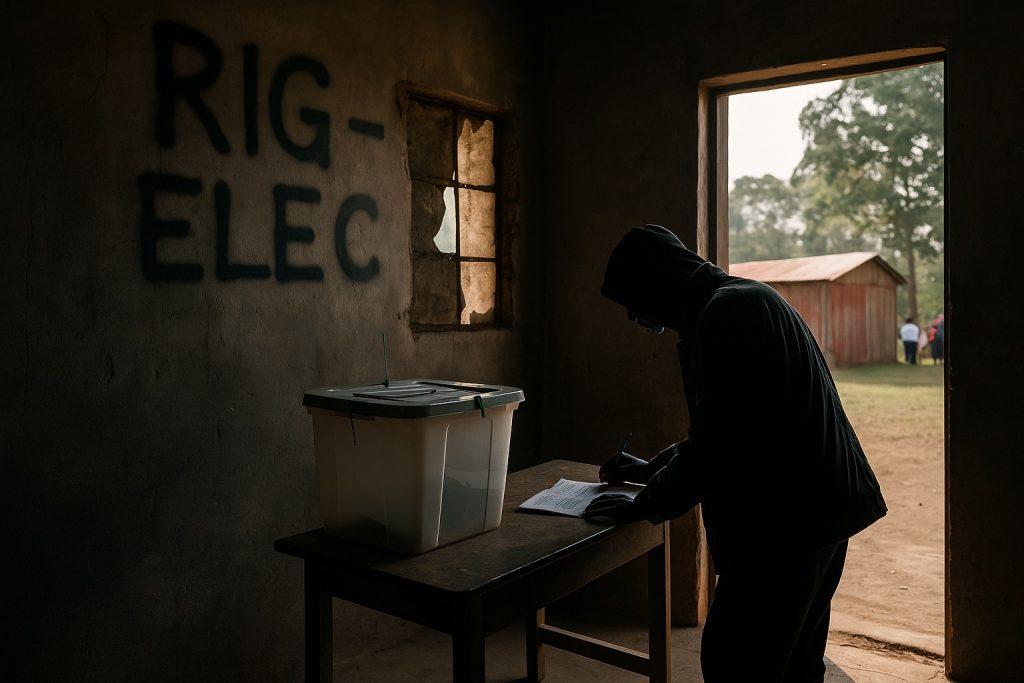
Last month’s by-election in Malava, Kenya wasn’t “just African chaos.”
It was the same tired script we’ve seen from Caracas to Minsk, just performed on a smaller stage:
And it didn’t explode overnight — it built over six quiet days.
Nov 21
Poll drops: ruling-party candidate 47.2% vs opposition 40.3%
→ The moment the race got tight, the air changed.
Same night
Gunfire in nearby Ugunja.
Message received: bullets now count as campaign ads.
Nov 22
Governor’s convoy ambushed in Kabuchai.
License plates are now target practice.
Nov 23
Presidential ally in Mbeere North openly warns “we can’t win fairly.”
They literally announced the rigging in advance.
Nov 27 (Election Day)
Candidates arrested.
Polling stations torched.
Mobs storm ballot boxes.
Turnout collapses — election suspended.
Six days.
That’s all it took for the gradient to become an avalanche.
Venezuela tested it in municipal races first.
Russia started in the regions.
Uganda perfected it in by-elections.
If nobody stops the experiment at the local level, it gets rolled out nationwide.
From the ruler’s spreadsheet, rigging isn’t a moral failure;
it’s the highest-ROI move on the board.
If I rig and win
100% stay in power
Full control of budget, mines, contracts, land
My kids, cousins, tribe eat for generations
If I play fair and lose
Prison or exile lottery
Lose the money hose
Assets seized the day I leave office
Seen through that lens, stuffing ballot boxes isn’t corruption.
It’s rational wealth-preservation strategy.
Short term: regime looks stable.
Long term: the bill arrives — and the country foots it.
Maduro, Museveni, Lukashenko, Hun Sen…
Same playbook, same graveyard.
Shouting “free and fair elections!” and sending observers doesn’t move the needle.
The reward is still galactic — and the punishment is still a joke.
The only language that works is making the cost of rigging higher than the benefit:
Do none of that, and democracy dies by a thousand local by-elections.
Malava isn’t some faraway village story.
It’s a beta test.
Your country probably has its own quiet six-day slope right now.
Explosions never arrive with a warning siren.
They arrive after weeks of “small incidents” nobody thought were connected.
If this unsettled you — that’s the point.
If it didn’t — history usually reaches the silent ones first.
Data Source Notice
This article is based on openly available news content collected through the GDELT Global Knowledge Graph (GKG). Tone metrics, metadata, and semantic clusters were processed using Infowider’s proprietary analysis pipeline. No information beyond what is contained in the original articles and GDELT data has been added.


