Physical Address
304 North Cardinal St.
Dorchester Center, MA 02124
Physical Address
304 North Cardinal St.
Dorchester Center, MA 02124
Date: February 5, 2026
Period: November 2025 – January 2026
Source: GDELT-based Global News Data
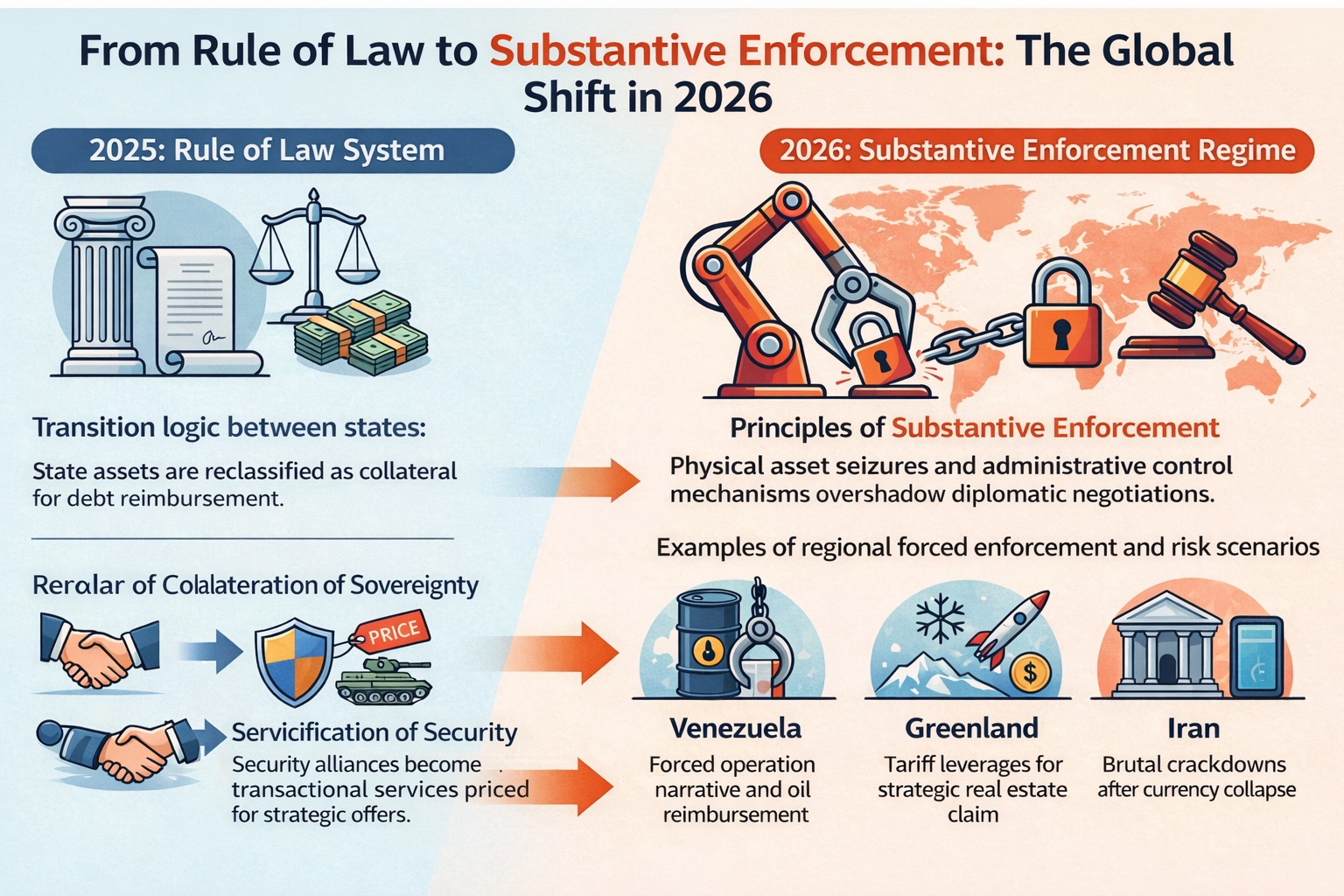
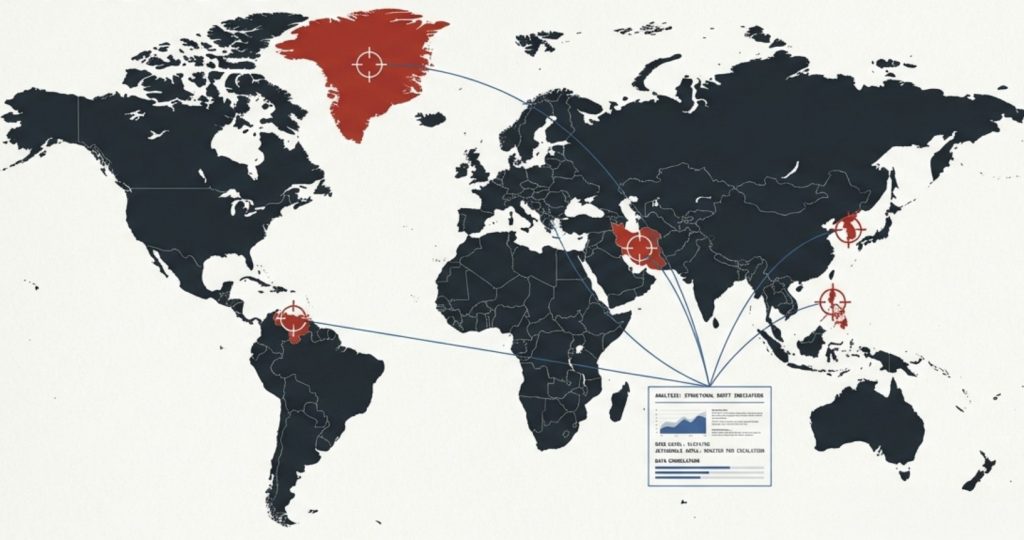
During the analysis period, global discourse shifted with growing clarity from a “Rule of Law” framework grounded in norms and procedures toward an order centered on substantive enforcement. This transition does not stem from a single event, but rather from the cumulative effect of policy choices and power exercises repeatedly observed across multiple regions.
The Collateralization of Sovereignty and Asset Recovery Logic:
Narratives surrounding reports and claims of operations targeting national leadership in Venezuela, followed by discussions on energy asset recovery, suggest that state sovereignty is increasingly being reclassified from an absolutely protected domain into one governed by debt, reimbursement, and compensation logic. This reflects a shift away from diplomatic pressure toward open discussion of physical and administrative control mechanisms.
The Transactional Nature of Security Alliances:
Debates surrounding Greenland and associated tariff threats reveal that security cooperation is being recalibrated from unconditional value-based alignment to transactional arrangements centered on strategic assets and cost-sharing. Territory, missile defense systems, and trade pressure are increasingly treated as a single negotiable package.
Hardline Responses to Internal Control Failures:
The prosecution seeking the death penalty for a former South Korean president and reports of mass crackdowns on protests in Iran demonstrate a growing tendency for political crises to be addressed through the most severe punitive and coercive measures available, rather than compromise. This indicates a shift where regime stability logic increasingly overrides individual legal and physical safety.
Overall Assessment:
The international environment is moving away from a venue of negotiation and norms, resembling what can be described as an “enforcement site” centered on physical control of assets, territory, movement, and power. Actors possessing enforcement capabilities are accelerating recovery and blockade measures, while those lacking defensive capacity are progressively pushed out of institutional protection.
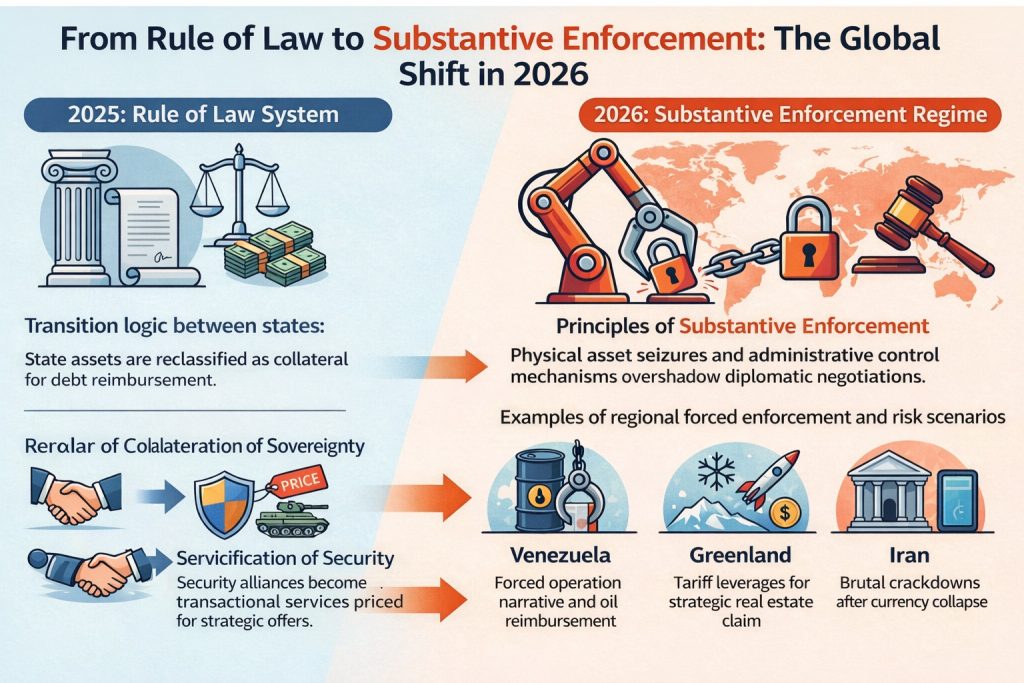
The core trends repeatedly observed during this period are “State as Enterprise” and the direct transfer of costs.
Worldview Shift:
Traditional sovereignty-respecting discourse is increasingly replaced by public justification of actions through compensation or reimbursement claims for past nationalization or contract breaches. In the Venezuela case, this framing prioritized asset recovery and control rather than democratic restoration.
Method of Enforcement:
Narratives criminalizing national leadership weaken sovereign immunity, enabling discussions of external intervention in resource management and trade conditions. This reflects a growing approach that treats the state not as a political community, but as a manageable asset bundle.
Cost Attribution:
Economic and social costs are borne primarily by the citizens and treasury of the affected nation, while recovered assets are subordinated to the strategic objectives of external actors.
Order Shift:
Security is no longer framed as an unconditional public good, but as a service contingent on payment and compliance. The Greenland debate illustrates how military strategic positions and missile defense systems are directly coupled with tariff and trade pressure.
Power Structure:
States with security provision capabilities increasingly leverage market access and tariffs, compelling allies to maintain relations through strategic asset provision or cost-sharing. Alliances are thus shifting from norm-based frameworks to transaction-based arrangements.
South Korea Case:
The prosecution’s request for the death penalty following the martial law incident can be interpreted as an attempt to define a clear tolerance threshold through the maximum punishment permitted by law for acts threatening constitutional order.
U.S. Internal Case:
Expanded immigration enforcement and references to the Insurrection Act suggest that border control logic is increasingly merging with domestic policing, implying that order maintenance may supersede individual mobility and rights even within advanced democracies.
Shift in Control:
Executive and judicial systems possessing enforcement and coercive capacity are strengthening their influence, while states with weak external defenses and individuals or groups that have lost political protection are becoming increasingly vulnerable.
While dominant trends favor forced enforcement, specific regions exhibit instability driven by institutional fragility combined with external shocks.
Observation:
Allegations of the disappearance of approximately $10 billion in flood control funds coincided with severe flood damage.
Structural Meaning:
The assumption that infrastructure investment directly yields growth is weakening; corruption is evolving from a financial loss into a direct survival risk.
Risk Transfer:
Institutional failure costs are transferred to citizens’ safety and lives, raising the probability of medium- to long-term political instability.
Observation:
Following sharp currency devaluation, international reporting highlighted expanding protests, communications blackouts, and estimates of mass casualties.
Structural Implication:
As state control erodes, reliance on information blackouts and physical force intensifies. This may either strengthen external intervention narratives or accelerate internal fortification strategies.
Observation:
Restrictions on third-party re-exports of advanced semiconductors and parallel efforts to build independent technology ecosystems are progressing simultaneously.
Risk Transfer:
Technology access is increasingly governed by security clearance rather than market logic, with neutral regions emerging as new friction points in U.S.–China competition.
The current phase can be described as a “forced realignment stage,” in which distressed elements are liquidated and control is reallocated. Major powers are reasserting influence centered on energy, security, and technology assets.
Risk has shifted from abstract loss to direct threats against the conditions of existence for individuals and groups.
Vulnerable Entities:
Resource-rich states with weak external defenses; individuals and groups stripped of institutional protection.
Fortified Entities:
States and alliances possessing coercive capacity, enforcement mechanisms, and tradable strategic assets.
Comprehensive Suggestion:
The first quarter of 2026 represents a transitional period in which enforcement precedes norms. Effective risk management now depends less on declarative principles and more on substantive control capabilities and the ability to set transactional terms.
This article is based on publicly available reporting from international news outlets. Analysis and
interpretation were produced by Infowider’s editorial framework. No claims have been added beyond
what is supported by the cited sources.


