Physical Address
304 North Cardinal St.
Dorchester Center, MA 02124
Physical Address
304 North Cardinal St.
Dorchester Center, MA 02124
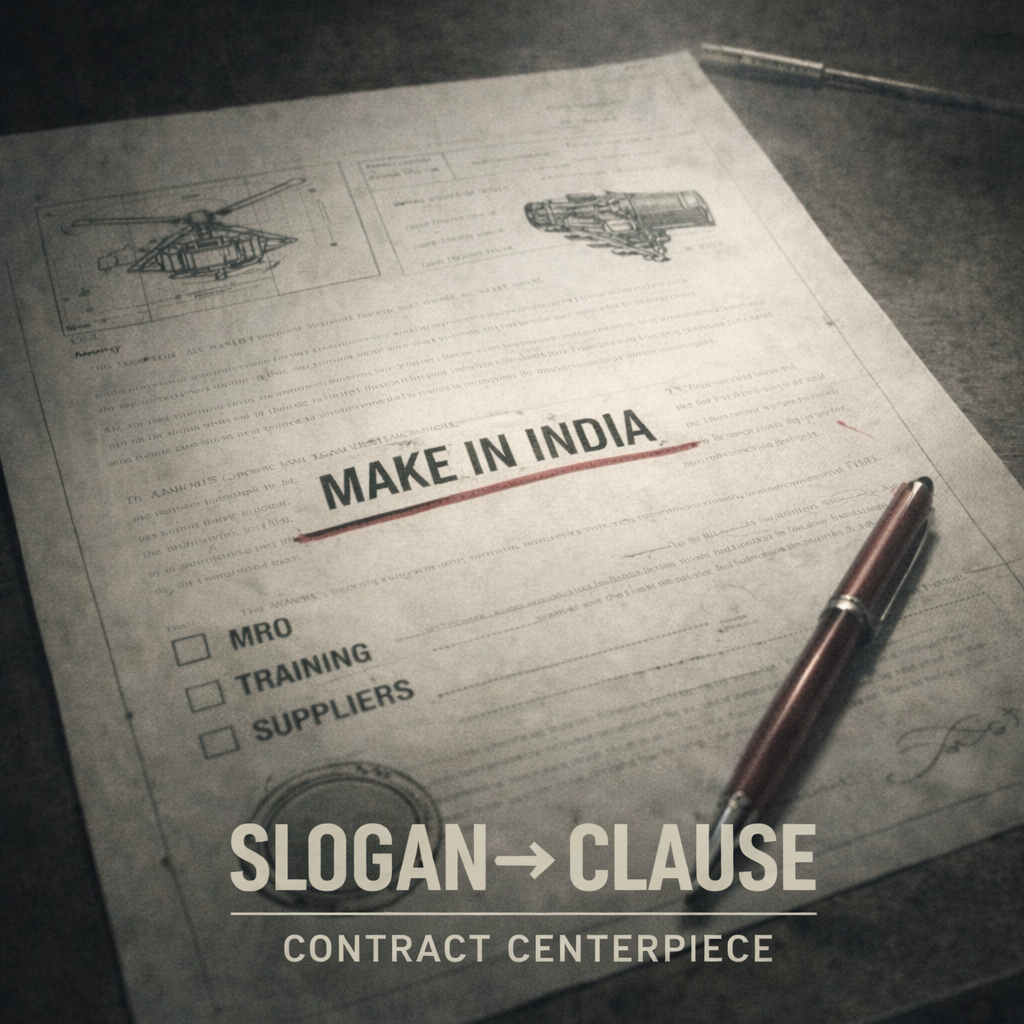
India–France cooperation is easy to compress into a headline number like “114 Rafales.” The number is real, but the settlement unit has shifted underneath it. This cycle is about domestic operating form: where production sits, who holds operating custody, and which supply-chain positions become irreversible inside India.
On the ground, India is behaving like an access platform rather than a pure buyer. Access is not just demand; it includes production sites, procurement procedure, certification pathways, and operational routing. Those pathways decide whether a system stays runnable when timelines slip, parts get constrained, or upgrades become urgent.

Punch: Access is a priced operating corridor.
In procurement terms, signatures and inspection custody show up first. A single line in a tender can decide who owns the inspection regime, where the MRO shop reports, and which authority can authorize deep maintenance without escalation. When acceptance authority sits abroad, the cost of delay is exported back into permission; when acceptance authority sits domestically, delay turns into a solvable operational problem.
This holds if market entry remains conditioned on domestic operating custody rather than symbolic localization language.
“Make in India” is not new; enforceable localization as contract grammar is the change. Rafale-114 reads less like a settled aircraft purchase and more like a negotiation over which layers are allowed to become domestic operating reality.
Punch: Localization is control allocation.
Assembly is shallow leverage. Run capability comes from supplier qualification, training pipelines, maintenance depth, and replenishment pathways that work under constraint. If those layers arrive late, operational dependency reappears through approvals during upgrades, resupply, and sustainment.
A procurement clause that specifies localization scope does three things at once: it places the cost when delivery or quality fails; it routes accountability when inspection disputes emerge; it defines whether upgrades and replenishment remain permission-bound under time pressure.
Operationally, Rafale-114 is still a contract-shape contest. India is trying to fix capability inside the country; France is trying to convert market access into revenue while protecting transfer boundaries. The effective “price” becomes the operating envelope: local content definition, maintenance depth, supplier seating, and contingency authority.
Punch: The price tag is an operating envelope.
A practical tell sits in the boring parts of documents: which subsystems count toward local content, who can execute deep maintenance domestically, and whether contingency upgrades and resupply require external authorization. If those answers harden in official language, the headline number moves to the surface and the operating corridor becomes the durable outcome.
“We do not want to be fully dependent on the U.S. and China’s technology models.” (reported paraphrase)
BEL–Safran’s HAMMER local production matters for the mechanism it installs: decision architecture. A 50:50 joint venture increases steering friction after production starts, and that friction is the point when dependency is measured in permission rather than in hardware.
Punch: Equity symmetry becomes operating custody.
Once production begins, supplier qualification lists, procurement standards, inspection routines, and accountability chains harden into daily reality. This remains true unless the JV is nominal, with inspection and acceptance custody effectively outsourced.
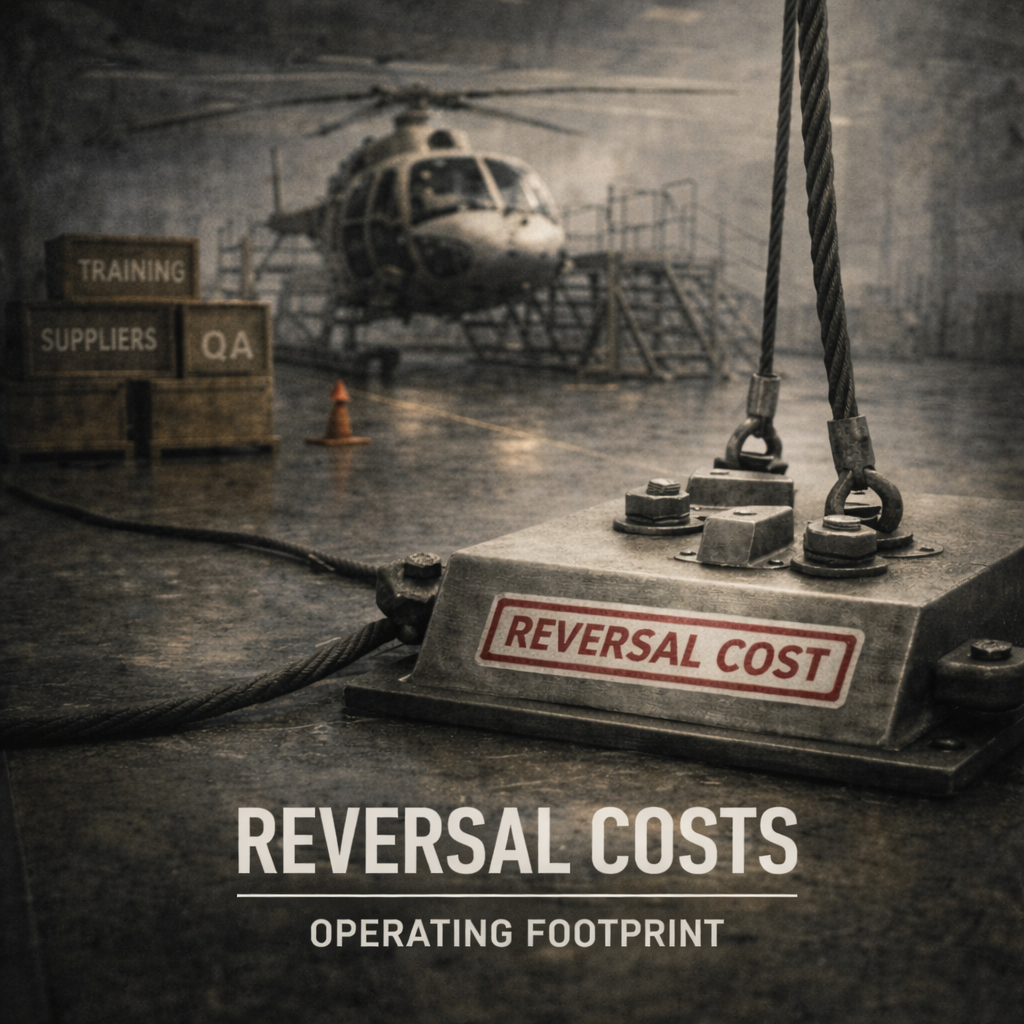
The Tata–Airbus H125 final assembly line is a permanent cost structure. Once the line exists, operations begin: training systems arrive, supplier networks form, standard processes harden, and quality responsibility becomes contractual.
Punch: Reversal cost is the stabilizer.
A shutdown is not the removal of equipment; it disrupts workforce pipelines, inspection regime, maintenance custody, supplier commitments, and export plans. The higher the reversal cost, the more cooperation persists through inertia rather than through rhetoric.
However, an assembly line does not automatically produce sovereignty. Sovereignty requires operating custody across deep maintenance, upgrades, and replenishment under constraint; without that custody, assembly can remain surface form that still depends on external permission.
Noise: Once the line is up, nobody wants to be the person who “turns it off” and owns the supply-chain fallout.
AI sovereignty does not persist as posture; it persists as nodes that run things. Institutional custody, compute scheduling, and deployment authority are the substrate. If those sit domestically, dependence shrinks in practice even when upstream components remain foreign; if those sit externally via contracts or managed services, sovereignty stays rhetorical.
Punch: Institutional custody is the sovereignty substrate.
An AIIMS-anchored health-AI center functions as an operating node, not a banner. It holds workflows, budgets, deployment authority, and operational responsibility, and it becomes the place where dependence is either reduced or reproduced through who controls deployment custody.
This India–France cycle leaves behind an operating unit only if domestic operating custody hardens in documents rather than in speeches: localization pressure around Rafale-114, a 50:50 HAMMER JV, an H125 assembly line, and an AIIMS-anchored AI node together raise reversal costs and thicken domestic custody, while the real test remains whether core-layer rights (deep maintenance, upgrades, contingency resupply authority) move far enough to keep operations runnable without external permission. The two numbers that will pin the settlement shift down are the Rafale local-content target discussed at up to ~50% and the HAMMER JV equity structure at 50:50; this conclusion weakens if localization demands materially retreat or if engine/MRO and upgrade authority are stripped back into assembly-only form. In 1H 2026, treat an official Rafale briefing or contract-language document that explicitly states the local-content ratio and engine/MRO scope as the confirmation point.
Macron Endorses India’s Rafale Jet Deal: Strengthening Defense and Strategic Ties
BEL and Safran to boost India’s defence with local HAMMER munitions production – BusinessToday
Modi, Macron inaugurate India’s first private helicopter assembly line in major aerospace push
India, France Launch Special Global Strategic Partnership
Macron, Modi AI Image & Summit 2026: India-France Tech Partnership
India-France AI in Health Centre Launched at AIIMS by Macron
This article is based on publicly available reporting from international news outlets. Analysis and
interpretation were produced by Infowider’s editorial framework. No claims have been added beyond
what is supported by the cited sources.


